Tuesday, June 19, 2018

Shadows and Fog

Shadows and Fog is a movie from 1991 that was written and directed by Woody Allen. It is available for rent on Amazon Prime.

In my opinion a work of art should be interpreted and evaluated on its own merits, as a unit, without reference to the biography of the artist and changing moral standards.

Shadows and Fog is a fascinating work of art composed of serious philosophical reflection, silly gags, cultural references, and special visual effects.

The movie considers all the Big Questions: what is the nature of reality, what is the meaning of life, what is our role in the larger universe, what is love, how is it different from lust, what is the value of marriage and family, what is evil and what causes it, what is the nature of political oppression and how does it work, does God exist, and, finally, what is the value of art. Barely a frivolous word is spoken in the movie, yet it is full of silly gags, jokes you might hear in vaudeville or melodrama.

The plot is generated by the problem of Evil, here personified by a homicidal maniac stalking the streets on foggy nights, and several murders are depicted with artful detachment. Overcome by fear and distrustful of the police, citizens have formed a vigilante committee, and they insist that Everyman join their cause.


Allen, the director, plays the nebbishy Everyman; he has been called to action by the Vigilante committee to combat Evil, but he can't figure out what to do or where to go. He seeks his way through a vague and undefined world symbolized by dense fog and evocative shadows.


Mia Farrow is Everywoman, who can swallow swords if need be, but wants only to raise a family.


John Malkovich is the Artist, who speaks for the creative life, and feels threatened by the demands of a family. He is a Clown, and his art is comedy. He says, significantly, "Nothing is more frightening than trying to make people laugh, and failing."

In the plot, the Sword Swallower and the Clown are part of a circus, where everything is an act, everything is an illusion, and reality is irrelevant.


Lily Tomlin plays the Whore with Heart, disillusioned and jaded, but broad-minded and generous. 


John Cusack plays the Smart Ass college student, who feels superior to everyone and doubts the value of everything.

In the plot, these two come together in a brothel, where Everyman and Everywoman also make an appearance. It is funny-ironic for characters to discuss love and marriage in a brothel.

One of the attractions of the movie is seeing so many well-known actors—a standard Hollywood ploy—in unusual guises.


David Ogden Stiers plays the Vigilante, who wakes Everyman from his sleep and demands that he join a plan to fight Evil, in the form of a maniac serial killer. 


Jodie Foster has a bit as a whore with fetching ringlets. 


Madonna plays a voluptuous acrobat. 

Much of the acting seems exaggerated, like the acting in a melodrama, because the actors are not playing 'real' characters, but roles in an extended existential joke.


Julie Kavner delivers a hilarious monologue as the Jilted Bride, eager to see Everyman dead because he humiliated her.


The key role of the Magician is played by a lesser-known actor named Kenneth Mars.

In the plot, the Magician saves the day—or at least foils the immediate danger—through the power of illusion; he captures the villain through trickery, or so it seems.

For art lovers, a major attraction of the movie is the look, composed of artful set design, stagey lighting, and very tricky cinematography. Some of the shots seem impossible. In one, the view goes from a closeup of a selfish Bitch standing in a second story window, pulls out to include back views of Everyman and Everywoman, moves clear around those two characters, and back up to the close-up in the window, without a cut. In another scene, the camera is in the center of a circle of Whores—talking about the role of illusion in creating sexual satisfaction—panning mechanically around, sometimes showing faces close-up, sometimes showing the woodwork and windows, just panning democratically around and around until Everywoman starts her lines, then it settles into extreme close-up, and our whirling feeling settles into attention.

Without getting into specifics, the score consists of clips of existing recordings. The music is circusy, discordant, old-fashioned, clanky. The melodies sound familiar but somehow off, inharmonious. This contributes to the carnival / whorehouse atmosphere, and the feeling that nothing is what it seems to be.

So, what is the meaning of all this melodramatic confusion? In the end the Artist discovers that family can be more satisfying than creativity, and so he agrees to settle down with Everywoman and make a family. Everyman finds his way at last by doing the thing he really loves. He apprentices himself to the Magician, ready to follow him at any price. Magic is defined as creating illusions, and symbolizes all the arts. If the universe is by nature chaotic and meaningless, the role of art is to make sense of things, to impose a temporary sense of order. Magic and Art satisfy the soul's quest for understanding and direction.

Monday, June 11, 2018

Gertrude Stein: Three Lives


Gertrude Stein's Three Lives is a literary masterpiece that everyone admires, and no one reads. Of those who do read it, few understand it. The reason is that it is innovative on many levels, and innovations have the big drawback of being shocking and disorienting.

The most shocking aspect is that the novel depicts women of the servant class with respect. The innermost lives of women who are generally overlooked and undervalued are studied with care and sympathy. The humble are raised up. In addition, Stein shows how being in service constricts their opportunity to develop a sense of self, and their lack of self-hood makes their lives futile.

The true subject of the novel is selfhood or authenticity; it's about free will and self-awareness. The three lives represent three unsuccessful stages of development of self-awareness, not culminating in fulfillment. Stein embodies these stages in fully-drawn characters, and then immerses these protagonists in detailed renderings of their social scene, peopled by vivid minor characters.

The first story is called The Good Anna. Anna represents the perfect servant, according to certain parts of the German-American community who adhered to old world traditions in the early 1900s. She devotes herself to service, both in her job and in her private life. She lives by an elaborate set of rules and strives to control everything around her.

Anna's life story is told through her relationships with others. We learn the complete life histories of her dogs, and we meet the under-servants that she scolds constantly, but her principal relationships are with her employers. First there's Miss Mary Wadsmith, "a large, fair, helpless woman, burdened by the care of her brother's two children." She manages that household for several years, until the girl gets married. Then Anna goes to work for Dr. Shonjen, a jovial bachelor doctor. When he gets married to a social-climbing woman, Anna goes to work for Miss Mathilda. This was the happiest period in Anna's life:

  • With Miss Mathilda Anna did it all. The clothes, the house, the hats, what she should wear and when and what was always best for her to do. There was nothing Miss Mathilda would not let Anna manage, and only be too glad if she would do.

Anna's only family is a half-brother, a wealthy fat baker, and his sharp-tongued wife. Anna does her duty, as she sees it, by their family, but she doesn't really care about them, nor they about her.

The romance in Anna's life is Mrs. Lehntman, a widow who supports her two children by working as a midwife. Anna is entirely "subdued by her magnetic sympathetic charm." Romance, Stein explains, is the ideal in one's life. The way this plays out is that Anna helps Mrs. Lehntman in all her endeavors—especially tending to poor young girls who are pregnant and alone. The two remain friends for many years, though Anna disapproves of some of her friends' actions and gradually gains a more realistic attitude toward her.

Anna's other friends are all needy and dependent. She spends all her spare income helping people who are sick, who have bad luck, who are too ignorant to care for themselves, who long to follow their dreams. She makes no effort to plan for her own future or to care for her own health.

Anna complains constantly about the failure of the people in her life to meet her high standards of behavior, but generally she finds both success and contentment in her work as a servant. But service is the only way of relating to people that she understands, and it is the basic rule of her life. When she comes to a point in her life when she can no longer work as a servant, she opens a boarding house, and basically works herself to death in the service of the poor young men who live with her.

All of Anna's employers and friends urge her to take better care of herself, but Anna is not really aware of herself. That is the problem: no sense of selfhood.


The third story is called The Gentle Lena. Lena represents a person who is totally lacking in self-determination; she is a good girl, meaning a good maid who does as she is told without complaining. Her passivity causes her to be pushed about; her lack of will or self-assertion condemns her to a short, unhappy life, ending in gray and miserable dissolution.

Stein represents Lena's sweet and gentle nature in a lovely passage:
  • Lena's german voice when she knocked and called the family in the morning was as awakening, as soothing, and as appealing, as a delicate soft breeze in midday, summer. She stood in the hallway every morning a long time in her unexpectant and unsuffering german patience calling to the young ones to get up. She would call and wait a long time and then call again, always even, gentle, patient, while the young ones fell back often into that precious, tense, last bit of sleeping that gives a strength of joyous vigor in the young, over them that have come to the readiness of middle age, in their awakening.
When we first meet her, Lena's life is an easy routine of housework and childcare, with an "unexacting mistress," and she is fairly content.

But Lena totally lacks will or self-determination:
  • Lena always saved her wages, for she never thought to spend them, and she always went to her aunt's house for her Sundays because she did not know that she could do anything different.
Several times, the author describes her with this phrase:
  • She was always sort of dreamy and not there.
Her downfall starts when her bossy aunt succeeds in marrying her to an unaware gay man named Herman who appears to be as bland and obedient as she is, despite the fact that neither wants to marry. Herman is a tailor. He works for his father and lives with his parents in the house next door. Though the family is prosperous, they are stingy with money and lax in their grooming.
  • Lena began soon with it to look careless and a little dirty, and to be more lifeless with it, and nobody ever noticed much what Lena wanted, and she never really knew herself what she needed.
The worst part of living with Herman's parents is that his mother harangues Lena constantly for not having their same stingy ways. Lena has no reassuring contact with old friends, who might come to her defense. Always dreamy, she becomes ever more absent and dull. When she gets pregnant, she is paralyzed with fear and sickness.

The only way Lena gets any relief is through the help of an old cook who intervenes on her behalf and starts a process that leads to Lena and Herman getting a separate house after the child is born. But neither having her own place nor motherhood is enough to lift her out of her despair.
  • This did not seem to make much change now for Lena. She was just the same as when she was waiting with her baby. She just dragged around and was careless with her clothes and all lifeless, and she acted always and lived on just as if she had no feeling. She always did everything regular with the work, the way she always had had to do it, but she never got back any spirit in her.
Herman's sense of self is awakened by his strong desire to be a father, and the pair have two more children. Herman takes over the care of the children, while Lena becomes more and more lifeless.

Lena's fourth baby is still-born, and she dies giving birth as well. Except for the 'good german cook,' no one cares. In fact, now Herman can raise his family without having to worry about her.


These two stories serve as book-ends or supports for the central story, Melanctha. Melanctha is a seeker. She says she wants to know the world, but what she is really looking for is unconditional love, expressed as unbridled passion. When you dig down into the depths of this story, you learn that she was unloved in childhood, both by her pale, ineffective mother and her absent brute of a black father. A psychologist might say that she never learned to love herself because her parents didn't show her much love. Early in childhood, she developed a cheery and helpful personality that hid her emotions and prevented her from making authentic contact with people. No one can ever love her enough to make up for her parents' neglect.

While Stein makes women from German culture represent suffocating tradition, she reaches into the African-American community to create a character on a quest. Her father is black, but her mother is described as a pale yellow colored woman. Stein makes much of the fact that Melanctha is half-white. Her personality combines the stereotypical attributes of the two races: smart and articulate like white people; passionate and wild like black people, all this according to the stereotypes of the time.

When we first meet Melanctha she is in high school and just beginning to explore the world of men. When she gets out of school, she doesn't seek employment. Just how she gets by is not explained, except to say that occasionally she does a little sewing for people. She spends more and more time hanging about with men; while she might not be hooking, she might be receiving various favors from admirers that help her get by. None of this is stated. Her circumstances are not important to the story. The story that Stein wanted to tell was about her inner life.

After a lot of romantic and sexual adventure, described in very vague terms, Melanctha rises to the point of engaging in a romantic relationship with a serious and virtuous doctor from the black community. The development, culmination, and decline of their romance is rendered with greater intimacy than any other fictional romance I know: we see exactly what Melanctha and the doctor think of each other at each stage of the process. From the beginning, they argue about authenticity. Doctor Jeff is a thinker, and has a lot of ideas about virtuous living that he likes to expound. Melanctha accuses him of ignoring his own principles; she says his behavior is not so virtuous as he likes to think. On the other hand, Doctor Jeff doesn't quite trust Melanctha; she always seems to be holding something back.

Despite these initial misgivings, the two are attracted to each other. Melanctha grows to like Doctor Jeff's warm and generous ways. Jeff is attracted by her beauty and her ability to articulate her thoughts, and he is charmed by the sympathetic way Melanctha listens to his incessant ruminations. Melanctha begins to hope he can make her feel secure. Their earliest conversations seem to be very authentic, each one expressing their truth sincerely. Stein allows them months of blissful wandering in nature and enjoyment of each other's company.

But there is a fly in the ointment, and that is the original question of authenticity. At the peak of their bliss, Melanctha does something, just some random gesture, that reminds Jeff of her other life, her life with other men, the world she doesn't talk about while she is listening to him so demurely. And in fact, Melanctha is not quite satisfied with Jeff either; she still thinks he is out of touch with his emotions; she secretly thinks he is sort of a wimp, but she has been submissive because she wants to please him. Stein depicts every step in the unwinding of their relationship. In the course of their arguments, they seem to cover every aspect of the search for authenticity that any psychologist ever identified, though they use everyday language, and are not sure themselves just what they are talking about.

Doctor Jeff drives himself crazy with too much thinking, but eventually he figures out that he was right all along. He rejects Melanctha's claim that he is hypocritical and inadequate; he rejects her neediness that manipulates him into expressing more than he feels; he rejects her inability to talk about her past life. He sees that some place along the way, she quit talking to him sincerely like an equal, and started putting on an act in order to bind him to her. Slowly and painfully, Doctor Jeff backs away, and resumes his quiet, virtuous life.

Melanctha, on the other hand, is unable to learn from the experience. She doesn't quite achieve a level of self-awareness that would enable her to learn from her mistakes; she is all instinct, driven by unquenchable psychological needs.  Generously, Stein allows her to meet the man of her dreams and to have the perfect all-encompassing romance, for awhile; but the man is a gambler, and when his luck runs out, his love fades as well. Players only love you when they're playing.

The strongest character in Melanctha's life is Rose Johnson. Rose is described as careless, negligent, and selfish, but she is completely authentic: she always knows what she wants, she always has an idea of how to behave to get what she wants, she always has faith in herself. Melanctha becomes more attached to Rose than to any of the men in her life, and will demean herself with any sort of service in order to be with her. But even Rose eventually rejects her. She too becomes concerned about Melanctha's other life, her secret interactions with unspecified men. She hates that Melanctha's self-defeating behavior patterns. She gets sick of her simpering submissiveness, hiding a wild and promiscuous personality. She totally disdains Melanctha's whimpering threats to end her own life.

Stein handles the rest of Melanctha's life in summary fashion. She gets very sick, with consumption or something; she gets well after long treatment. She takes an actual job as a servant, and attempts to live a quiet regular life, but her health is compromised, and she dies young. Sad story.

An aspect of the novel that sounds harsh to the modern ear is Stein's use of stereotypes in building her African-American characters, including the use of the word 'nigger.' However, you notice that she uses positive as well as negative character types, and she makes each character rise above type into eccentricity and particular traits. Moreover, her German characters are all stereotypes as well. All the characters conform to some known type, but the way they talk and the details of their lives are highly individualized and convincing.


On top of innovations in subject, theme, and structure, Gertrude Stein invented her own writing style, an elusive style that sometimes serves as a barrier because people reject its lack of conformity. The most obvious feature is repetition—repetition of descriptive phrases, sentences and whole paragraphs. Characters may be described with the same phrase in one situation after another, but each time that phrase relates to new phrases. She treats phrases like shapes that can be repeated in different parts of the picture. Whole anecdotes might be told in the beginning and repeated at the end of a story. For instance, Melanctha's story opens with an event in a friend's life: Rose Johnson has a hard time with her baby. That anecdote is repeated toward the end of Melanctha's story, after we learn a lot about Rose and Melanctha.

This aspect of Stein's style has been compared to Cubist painting, because it looks at a subject from different angles, and builds up a picture from layers. Repetition of phrases, sentences, and paragraphs also makes it sound like music; repetition is like the chorus in a song. These stories sound a little like long ballads.

For the critics of Stein's time—who were steeped in the stilted prose of the 19th century and enthralled by the elaborate sentences of Marcel Proust and James Joyce—the ordinary, everyday quality of Stein's language and sentence structure must have seemed primitive. Stein's vocabulary is about 6th grade level, maybe lower, the type of words used by the servant class. The most complex psychological concepts are alluded to vaguely by everyday words, vernacular speech for German maids and women in the lower levels of the black community.

Stein also minimized punctuation: no colons or semi-colons, only commas allowed, and only when really necessary. Similarly, no capitol letters: she refers to 'german' girls.

More remarkable, Stein doesn't use subordinate conjunctions, like 'although' or 'since', to show relationships between facts or ideas. She tends to string simple sentences together with 'and,' piling up details one at a time. Nor does she use a lot of modifying prepositional phrases, such as 'despite her reluctance…' The result is, the novel can be read very rapidly; it sounds like ordinary conversation. Stein's style is so fluid that she moves in and out of the thoughts of various characters without the reader noticing the changes from one to another. If you let down your resistance, the novel sounds like a long sad song cycle.

Three Lives is a hard book to put down. It sort of seeps into your soul.


Thursday, May 24, 2018

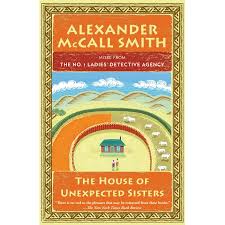
The House of Unexpected Sisters

Although Alexander McCall Smith is "only a man"—and a Scotsman at that—he tries to create a story world that is dominated by women and women's values in his latest novel The House of Unexpected Sisters. The values he expresses in his heroine are sympathy and understanding, compassion and cooperation, toleration and forgiveness.

The context for this fantasy is an idealized country in Africa, called Botswana. While Botswana is a real place, and all the place names and geographical features described in the book are real, the country in the book is an ideal place, a sort of Heaven on Earth, where people act with respect for themselves, for other people, for tradition, and for the land.

The House of Unexpected Sisters is the 18th novel in Alexander McCall Smith's The No. 1 Ladies' Detective Agency series, which features Precious Ramotswe, who has created herself as the first lady detective in Botswane. The name 'Precious' is traditional in her country, but it also symbolizes her character, like the name of her assistant, 'Grace.' Precious is exquisitely sensitive to the feelings of others and couches every utterance as tactfully as she can. Her investigations are slow and polite; no violence, no speed, no threats, no danger. Just complexity—overlapping motivations, misunderstandings. Some problems seem to be solved by the mere process of investigation.

Her clients don't bring her the big scary problems, like murder and gang activity. That stuff naturally goes to the police. They come with vexatious problems, like a rash of petty thefts in one of the stories; the culprit in that one turned out to be a mischievous wild monkey. There might be a question of suspected impersonation, or suspected adultery. In this book the problem is wrongful termination; a client says she was fired for no good reason. Investigation of that issue reveals various other shenanigans by the people involved. And, very realistically, Precious has some problems of her own to work out. I think it won't be too much of a spoiler if I tell you that everything comes right in the end, and everyone gets justice.

The book's theme is indicated in the title, and it is a basic tenet of feminism: women stick together, women support and encourage each other, women are sisters by nature. All of the women in the story, except for the villainous Violet, cooperate to bring about equitable solutions.

And what sort of roles do men play in this feminine universe? Precious' husband isn't nearly as smart or useful as her friends, but he loves and supports Precious as well as he can. One of her part-time assistants is a mousy male, retired and feeling useless, who has a good heart and occasionally a good idea. Her first husband, Note, has been a villain throughout the series—having battered Precious during their marriage, and returning now and then to cause her trouble. Her late father was the epitome of wisdom and virtue. The employer who is accused of wrongful termination is a philanderer. In general, men make a mess of things, and women set things straight again.

This novel is not what you would call great literature. It's so easy you can read it while waiting in line at Starbucks, as I have. In fact, the series makes great reading for jet travel; I discovered my first one at an airport bookstore. You could say that McCall Smith churns this stuff out exactly for that purpose, especially for women passengers. However, that doesn't mean it is without charm. The culture of Botswana, both real and imagined, is very colorful and exotic. The characters are irresistibly nice; it is soothing to hear the way they reason. And it seems clear to me that the author genuinely cares about the values he depicts, and he is genuinely fond of the way women do things.

Sunday, May 20, 2018

Theodore Wores, 1859-1939

A delightful remnant of the past has been rescued from oblivion by the Triton Museum of Art in Santa Clara, with the help of the Farrington Historical Foundation, and is presently being featured in a special exhibit at the museum, called "Theodore Wores: Under the California Sun."

Twenty-three lovely Impressionist landscapes by pioneering California painter Thomas Wores, including scenes from the Santa Clara Valley, the San Francisco coast, and the dramatic valley of Yosemite, were discovered in storage at the museum by its Deputy Director, Preston Metcalf.

These paintings date from 1912, when San Francisco was still surrounded by sand dunes covered in blue lupine, from the 1920s when Saratoga was synonymous with orchards, from the 1930s when Yosemite was still a rare sight. Metcalf, who grew up in Santa Clara in the 1960s when some of these scenes still looked much the same, recognized the historic and nostalgic significance of these works now that so much has been paved over and polluted, so he determined to secure funding to have them restored and exhibited. From the Triton, the show will move to other venues around the state.

1910-1920

The Sand Dunes of San Francisco, Ca, 1912

Blue Lupines of the Sand Dunes of San Francisco, c. 1912

Entrance to Golden Gate, c. 1914
1920s

Tree Blossoms, 1920

Peach Orchard, Saratoga, California, c. 1925

Road with a Blossoming Orchard, 1925

A Garden in Saratoga, California, 1927

My Studio Garden in Saratoga, Ca, 1926

My Summer House, Saratoga, Ca, 1928

1930s

Yosemite Valley, California, 1931

Yosemite Valley, California, 1931

From the point of view of art history, Theodore Wores is significant because he was one of the earliest California-born artists to achieve international fame in his own time. Wores was born in San Francisco—to parents who had fled the war between Austria and Hungary—and at the age of 16, he became one of the first students at the San Francisco School of Design, the first art academy on the West Coast.  The following year he moved to Munich, where he studied for six years. After several years of building his career in different locations, Wores settled in San Francisco. Now a well-established painter, he became a Dean at the San Francisco Institute of Art, which was the current name of the academy where he first studied art.

The Iris Flowers of Hori Kiri, Tokio, c. 1893
Crocker Museum / Jan's photo, 2010
Wores' best work depicted "exotic" scenes—in Chinatown, Japan, Hawaii, Samoa—in a style that was heavily influenced by his academic training. 

The landscapes in this exhibit, done in a softer, brushier style, are minor works, but they have a special appeal for folks in the Bay Area, and the longer you look at them the more you appreciate their high quality.

In 1924, when Wores was in his mid-sixties, he acquired a second home and studio in Saratoga, and painted many Impressionist depictions of the orchards surrounding it. The paintings in this show were donated by his widow, Carolyn Bauer Wores.


Monday, May 14, 2018

In Cold Blood


The big question in the non-fiction novel In Cold Blood by Truman Capote is why murder a family of four people, why invade their home in the middle of the night, tie the up, gag them, and shoot them in the face with a shotgun? The answer is fairly simple, actually; the murderers were psychopaths, meaning they had no conscience and no attachment to life, to other humans, or even to their own life. But it doesn't seem obvious to the neighbors of the victims, to the investigators, or even to the reader. It seems senseless and horrific, and you have to wonder how anyone's personality could become so warped that they would commit mass murder.

Capote developed several innovations in order to consider this problem. In the first place, there's is no suspense in the usual sense: Capote used a famous murder case in which the perpetrators had already been convicted and hanged by the time the book was published. But for the detectives there is plenty of suspense; they have a real "who done it" with very few clues. Capote develops the characters of a few of the detectives, and follows them in their investigations, so that the reader feels their suspense. There is also plenty of suspense for the people who knew the murder victims—the prosperous Clutter family—as they all begin to suspect each other, and to be fearful about the future. The characters of a few of these people are sketched in as well, so the reader absorbs their suspense.

The innovation that set the literary world abuzz was that the novel occupies a new space in between factual reporting and fiction. Capote conscientiously reports every scrap of evidence, even false leads, what would be 'blue herrings' in a British mystery show. He reports every interview. He quotes from the detectives' notes. It's a wonder that he can keep the reader interested in all this minutia. But he escapes the bounds of journalism by using the facts to conjure scenes, complete with atmospheric details and dialog that the author could not have heard. Of course, some people object with his taking this much license, but that's what makes it a novel; otherwise, it would just be journalism, and nothing new in terms of form. Also, it would not have become a major hit in the publishing world. People were already familiar with the basic facts of the case; it is the imagined part that holds your attention.

A third quality of the novel is harder to describe. Usually the narrator of a novel has a consistent voice, a sort of attitude, a point of view. In Cold Blood is presented in the form of reports from the participants, so the point of view is constantly shifting. Part of the story—part of the evidence—is told from one character's point of view, part from another, following several characters. The reader hardly notices any general narration pulling all these "factual" reports together.

Instead of a voice, the novel has style, a truly exemplary style of using the English language. Capote's sentences are remarkably clear and graceful—just the right choice of words, the perfect word order, no clutter or self-consciousness. Each sentence calmly, sensibly, sympathetically leads to the next.

The reader experiences the magnitude of the crime—we meet the victims and hear their dying words as they are slaughtered methodically. We experience the gnawing hunger for answers that motivates the lead detectives in the case. But most importantly, we get an intimate look at the childhood and development of psychopaths, not just the two murderers in this case, but of other mass murderers as well, plus the text-book description of this pathology. And the result is the reader feels some empathy with them; you can see how a neglected and abused little kid could become angry at the world; you can feel how much they needed a little love and guidance when they were vulnerable. People aren't born psychopaths; it's a result of the way they are treated in those early years; maltreatment warps their personalities. Which is not to say you sympathize with them. No, hanging seems the right punishment in the situation. They seem irredeemable. They don't even care. They place no value on their own lives, never did.

Saturday, May 12, 2018

Wayne Thiebaud, from 1958 to 1968


Born in 1920, Wayne Thiebaud, now 98, is the grand old man of California painting. Since the 1960s, he has consistently produced cutting-edge paintings that everyone could understand and appreciate, not an easy combination to achieve.

Because Thiebaud spent several years working as a designer and a cartoonist right after high school, and he served a hitch in the Army Air Force during World War II as well, he didn't get started on his career in the fine arts until the 1950's. At the age of 30 he enrolled in Sacramento State College (now California State University, Sacramento), and by the age of 40, in 1960, he was an assistant professor at the University of California in Davis. Thiebaud remained at Davis until 1991, 31 years. This career stability gave him the freedom to pursue the art values that interested him. Thiebaud's career went through a half-dozen phases, taking up one subject after another, and adapting his technique to make his ordinary subject matter look exceptional.

Thiebaud first attracted wide-scale attention between 1958 and 1968 when his simple renderings of common food items available in diners and bakeries, cafeterias and delis fit right in with Pop art and the fad for elevating commerce in art. A special exhibit of Thiebaud's work during this period was presented as its inaugural show by the new museum at UC Davis, the Manetti-Shrem Museum.

Beach Boys, 1959
Special exhibit, Manetti-Shrem Museum / Jan's photo, 2018
Before Thiebaud developed his signature style, he experimented with one of the styles that was popular in the Bay Area, figurative painting with heavy impasto, or thick application of paint with expressionistic brushstrokes. 


Pancakes, 1961
Special exhibit, Manetti-Shrem Museum / Jan's photo, 2018
His rediscovery of the still life was a major breakthrough. The tradition of painting food and tableware dates back to the Dutch Golden Age of the 1600s, but in the 1960s still life was considered too tame. Thiebaud reinterpreted the still life for his era, while also turning from the sumptuous repast of tradition to the lowliest, and loneliest, meal in a diner. As a work of art, this composition is interesting for the way the artist conveyed three-dimensions on a flat structure; also, the brushstrokes are flatter and more controlled, and distinct outlines define the objects.


Delicatessen Counter - Bologna and Cheese, 1961
Special exhibit, Manetti-Shrem Museum / Jan's photo, 2018
As a subject, a deli counter is even more detached than a meal for one, removing any emotional connotations. The emphasis is on the geometry and the colors; the image is close to abstract, barely tied to reality. The brushstroke has been carefully controlled in order to define shapes as well as to suggest the texture of the deli items.


Delicatessen Counter, 1961
Special exhibit, Manetti-Shrem Museum / Jan's photo, 2018
This painting shows amazing control of the brushstroke to define shapes and especially to mimic the textures of the food items. The artist was very interested in the way paint compares to the textures of the subjects he is depicting. The composition is based on a strong and stable geometry. 


Drink Syrups, 1961
Special exhibit, Manetti-Shrem Museum / Jan's photo, 2018
At the level of subject matter, Thiebaud documented certain objects and customs that no long appear in the same form; this row of drink syrups must have been intended for snow cones, but I believe they usually come in bottles nowadays. The dispensers have been simplified to their basic geometry, removing all associations and connotations, making them merely containers for the primary colors, with blue added in the triangular base, making this sort of an art joke. Thiebaud enlivened his dull subject with colorful and vibrant outlines.


Sucker Tree, 1961
Special exhibit, Manetti-Shrem Museum / Jan's photo, 2018
Have you ever seen a cone, perhaps styrofoam, with branches formed by lollipops? It looks like a relic of the past. The subject gave the artist the chance to play around with angles of placement for circular shapes on a flat plane as well as with types of patterns within a circle, requiring very precise brushstrokes.


Refrigerator Pies, 1962
Special exhibit, Manetti-Shrem Museum / Jan's photo, 2018
Thiebaud is most associated with paintings of cakes and pies, not the homemade type, but products available in bakeries. His goal here is to make the paint mimic the textures of the food; the chocolate cream pie looks luscious. He simplified the shapes to their basic geometries and arranged them uniformly, cropping out any context of the bakery.


Cream Soups, 1963
Special exhibit, Manetti-Shrem Museum / Jan's photo, 2018
Again the artist strides the border between realism and geometric abstractionism. Oil paint has been mixed to the creaminess of soup, but the shapes have been simplified to basic circles, and modified in size and shape to indicate depth. Vibrant outlines in arbitrary colors make the shapes lift off the canvas.


Football Player, 1963
Special exhibit, Manetti-Shrem Museum / Jan's photo, 2018
In his next phase, Thiebaud turned to the figure, however, as with his still lifes, he treats the figure more as an object than as a person, simplifying the component shapes, eliminating personal detail, and reducing the figure to a bold icon; he barely gave the figure a place to sit, though he placed it in a seated position. The helmet and mask are perfect because the artist is not interested in the football player as an individual, or even as an athlete; he is interested in the figure as object, and about playing with modeling and dimensionality.


Man Sitting - Back View, 1964
Special exhibit, Manetti-Shrem Museum / Jan's photo, 2018
It is quite surprising to see the rear view of a lone figure in a painting. Is it a statement about alienation and isolation? Is this the poor guy about to slurp up cream soup? Or is it an exercise in treating a figure as an object, creating convincing roundness and depth of shape without any supporting context, just perfect horizontal brushstrokes. The figure doesn't even get colorful contours except in the difficult area where the bottom meets the seat.


Standing Man, 1964
Special exhibit, Manetti-Shrem Museum / Jan's photo, 2018
This figure is all suit and no personality. Brushstrokes are virtually invisible and details have been eliminated. The question is how does light fall on a standing subject? The objective is to convey modeling through light and shadow; to make the figure look like it is really there, though there is no definition of any particular space, except for a single horizontal line to represent the floor.


Woman in Tub, 1965
Special exhibit, Manetti-Shrem Museum / Jan's photo, 2018
Isolation, alienation, and sterility are conveyed in this image; there's no denying its emotional content. The tub is indicated by a few colorful horizontal lines on a ground of flat whites and grays. The head is photographically real but dehumanized by its position. If there is a person in that tub, she is lost in revery, her personality withdrawn and at rest.


Five Seated Figures, 1965
Special exhibit, Manetti-Shrem Museum / Jan's photo, 2018
Like still life, the group portrait dates back to the Dutch Golden Age, but Thiebaud reinterpreted the subject to leave out the "groupiness" of the group. By their positions ignoring each other, you see these people are not in the same room at the same time. The artist probably painted a separate portrait of each person, then combined them arbitrarily into a design. He treated the figures not as people but as objects. Perhaps the artist is saying "This is the way the world is; no one pays attention to anyone else; each is a self-absorbed unit." Or it could be a study of how the light falls on faces looking 5 different directions, how light and shadow models legs and shoulders, how to create enough space for 5 chairs and get all the legs to overlap convincingly.


Girl with Mirror, 1965
Special exhibit, Manetti-Shrem Museum / Jan's photo, 2018
Here is a girl with great breasts and a solemn expression. If the face were smiling or looking up, the image would be erotic, but the girl herself is absent from this figure. This beautiful torso is treated as an object, like one of Monet's haystacks, for studying light on organic shapes and the amazing range of shades and tints included in "skin tone." Brushwork is very refined and smooth.


Wayne Thiebaud is a traditional realist with a contemporary twist. He hides systematic variation of abstract aesthetic values in the form of ordinary objects and detached figures. During the first decade of his career, covered by the special exhibit at the Manetti-Shrem, his work grew increasingly complex and subtle, while he examined the traditions of still life and figure painting. This was only the beginning of a long and beautiful career.

Tuesday, May 1, 2018

Breakfast of Champions


I didn't like Kurt Vonnegut's novel Breakfast of Champions. I should have liked it—Vonnegut is an extremely important 20th century writer. I expected to like it—I liked several of his other novels. I tried to like it—and there are brilliant passages in it. But it the end, I was just glad it was over with.

At the largest level, the problem is that Vonnegut interweaves fantasy with reality, and fantasy with fantasy. One of the characters is supposed to be the author, and he interacts with the characters he has created; he gets badly mauled by a dog of his own creation. He creates and uncreates characters, moves them to different times and places, and offers commentaries on his reasons.

At the stylistic level, Vonnegut's prose is choppy, partly because he keeps darting around in overlapping universes. The other reason is that he throws in so much minutiae of verisimilitude that there is a long distance between subject and action.

Thematically, the problem is nihilism. The author and his surrogates are at pains to point out and illustrate the banality and inanity of modern life, presumably for comical effect. This is a dystopian novel, no holds barred.

None of the characters is developed in a sympathetic way; they are basically place-holders in a game of 3-D chess.

Existentially, Vonnegut wanted to show the interconnectedness of everyone's stories, the absurdity and tragedy in everyone's lives, and the futility of the whole flawed human enterprise.

You have to be the right age to appreciate this type of bitter humor and this casual way of mixing fantasies like cards in a deck.

So, if I disliked it for all these reasons, why did I keep reading it? Because some of Vonnegut's ravings express his insights in a unique and impactful manner.

Here's a paragraph that aptly describes his intentions:
"I resolved to shun storytelling. I would write about life. Every person would be exactly as important as any other. All facts would also be given equal weightiness. Nothing would be left out. Let others bring order to chaos. I would bring chaos to order, instead, which I think I have done (my italics). If all writers would do that, then perhaps citizens not in the literary trades will understand that there is no order in the world around us, that we must adapt ourselves to the requirements of chaos instead. It is hard to adapt to chaos, but it can be done. I am living proof of that: It can be done."

Here's a funny line that is still apt:
"Much of the conversation in the country consisted of lines from television shows, both past and present."

Here's a good description of women's defense mechanisms:
"The women all had big minds because they were big animals, but they didn't use them for this reason: unusual ideas could make enemies and the women, if they were going to achieve any sort of comfort and safety, needed all the friends they could get. So, in the interest of survival they trained themselves to be agreeing machines. All their minds had to do was to discover what other people were thinking and then they thought it too."

For a major fan of Art History, the most interesting part was a commentary on the Minimalist paintings by Barnett Newman, who puzzled art-lovers with canvases bearing only one or two stripes on a uniform background. Here's an example of Newman's simplest composition, grandly called Onement:

Onement, 1953 by Barnett Newman
Internet 
To carry his interpretation, Vonnegut creates a character called Karabekian who has painted a work called The Temptation of Saint Anthony. He then places the painter in a bar scene where the patrons scorn his work, saying a child could do better. This quote is his response:

The painting did not exist until I made it…Now that it does exist, nothing would make me happier than to have it reproduced again and again, and vastly improved upon, by all the five-year-olds in town. I would love for your children to find pleasantly and playfully what it took me many angry years to find…
It is a picture of the awareness of every animal. It is the immaterial core of every animal–the ‘I am’ to which all messages are sent. It is all that is alive in any of us–in a mouse, in a deer, in a cocktail waitress. It is unwavering and pure, no matter what preposterous adventure may befall us."

Just because I didn't like the novel doesn't mean I didn't appreciate it. But I'm eager to get onto something richer and more satisfying.