Tuesday, July 17, 2018

René Magritte: The Fifth Season


"The Fifth Season" is an exhibit of paintings by René Magritte (1898-1967) now showing at the San Francisco Museum of Modern Art. It features work from the latter part of his career, starting with the 1940s, when World War II was raging in Europe.

I've been a fan of Magritte for a long time, but I gave up trying to figure out the meaning of his paintings at the Royal Academy of Art in Brussels, which had more works by this highly prolific artist than I could digest in one afternoon. However, after viewing this well-arranged show, with seldom-seen works borrowed from all over the world, and doing some online study, I suddenly had a feeling that I could understand the paintings now. I thought I would share my thoughts in hopes that the reader might be stimulated to put on their own interpretative cap: the "true meaning" is up for grabs.

The Human Condition, 1933
In the 1930s, Magritte was a well-known Surrealist. His images combined hard-edged realism with optical puzzles that played tricks between images and the realities they depict. He complicated the matter by assigning the works weighty titles that apparently bear no connection with the subject. My interpretation of this work is that the human condition is such that we mistake illusion for reality; we are deluded.

The Return, 1940
Here the silhouette of a bird in flight is filled with very realistic clouds of a daytime sky. The setting is a dark night where trees are silhouetted in black, as you would expect. In the foreground is a naturalistic depiction of 3 perfect eggs. If the bird form represents the soul, and the eggs represent the birth process, we might have a statement about death and rebirth, or the eternal life of the soul.  

During the 1940s, Magritte abandoned his signature flat style, and experimented with brushier styles, such as Impressionism, Expressionism, and Fauvism. The generally accepted explanation is that he felt disillusioned and alienated during the German Occupation of Belgium. Magritte was born in Belgium and lived there most of his life, and he stayed in Brussels during the Occupation.

I think his reasons may have been more artistic than war-related. Even though his brushstroke might be loose to the point of messiness, his tricky turn of thought is very recognizable, and there is no emergence of social or political themes. Nazis were not keen on Surrealism, and it could be that he wanted to cloak his haunting questions in styles that had proved acceptable. It could also be that as an artist he was saying, "Even when I change my style, I'm still myself." It should also be noted that during this time Magritte was supplementing his income by selling copies of other artists' works.

The Fifth Season, 1943
The show was named for this crude and brushy painting of two anonymous similar men carrying paintings in opposite directions. One carries an image of the forest; the other an image of the sky. There is something sombre about this work; the artist doesn't know whether he is coming or going; dragging himself though his routine, he perseveres in his effort to sell paintings. This painting is very much in the manner of Edvard Munch, a contemporary whose roughly rendered figures are doubtful and confused.

Forethought, 1943
By shocking contrast, Magritte painted this utterly delightful bouquet, worthy of Renoir or Monet, in the same year. Surrealism as a movement was over at this point, but as a style, this painting clearly shows a similar way of thinking. The flowers are wonderfully convincing, but examples of several different species are growing on the same plant, which is more like a tree than a bush, and which looms gigantically over a serene impressionistic landscape.

The Harvest, 1943
In that same year, Magritte made a little art history joke. There was a long tradition of treating the reclining nude in this posture with upraised arm and sleeping or dreaming face. Historically, she was supposed to be receiving the god Zeus in the form of a shower of gold; so she might be blissed out, so to speak. In this case, instead of Zeus hovering overhead, she has a dream of a beautiful, fertile landscape in the background. The surreal element is the body's coloration; if you had been in contact with a supernatural power, you might feel he had brought out your true colors.

Elsinore, 1944
This picture shows a figure of a castle combined with that of a forest in a green land under a cloudy sky. Elsinore is a real port in Denmark, and it is also the name of the Castle where Hamlet lived with his benighted family. Again, this painting makes me think Magritte was seriously exploring the styles of other painters because it looks so much like the forest scenes of Gustav Klimt, another contemporary artist.

Image with a Green House, 1944
Can we squeeze in a little music? The world is very regulated and insulated, very closed and overheated—is anyone making room for culture? The title directs us away from the violin, which is trying to hide in the shadows.

Intelligence, 1946
Here we have two identical men wearing masks and caps looking at each other as though they were scheming. Behind them are icons of industrialization. On the right is a candelabra-like figure with three identical female faces gazing toward the men with very expressive looks. The color scheme is overheated. Once again, culture appears to be threatened. Perhaps a painting like this does show alienation; the painter feels that his values are threatened.

The Cut-Glass Bath, 1946
This little work from the same year, a gouache on paper, is a straight-forward wine-drinker's joke. Want to feel as lofty as a giraffe? Have a nice glass of wine; it centers you, as shown by the concentric white brushstrokes.

By the late 1940s Magritte had resumed his signature crisp style, and added new complications to his philosophical themes. The War was over and life was starting to return to normal. The art market was waking up, and his contemporaries were pumping out work in fresh styles.

The Liberator, 1947
Magritte's hard-edged super-realism has returned with this image, along with cynical wit. Whatever the liberator is, he ain't what he's cracked up to be. His promises are just castles in the air.

The Pebble, 1948
Here Magritte clones the late style of fellow surrealist Georgio de Chirico to present a frank image of a woman masturbating. She is in a room that morphs into the ocean, suggesting that auto-eroticism can take you away from it all. The experts who mounted the show worried about the painting's title; I think the meaning would be evident to any woman similarly engaged.

Sheherazade, 1950
Sheherazade is a character in a collection of Middle Eastern folk tales first compiled in English in the early 1700s. She is a young woman who attempts to trick a sultan who has a practice of bedding a virgin every night and beheading her the next morning. She forestalls her own death by telling the king a fascinating story, and stopping each morning before it is finished. She has prepared herself for this challenge by absorbing all the great literature and histories of her time. She holds the king's interest for 1001 nights—which would be over 3 years—by which time, he is in love with her. He marries her and makes her his queen. Which says a lot about the value of story-telling and the imagination. Magritte represents this magical person as a bejeweled carnival mask; she is the ultimate mystery because she contains infinite wisdom.

The World of Images, 1950
This sunset is so gorgeous that it burst through the window.

The Survivor, 1950
This is the most pointed and poignant of Magritte's images, a weapon covered in blood. Its placement in a homey, well-lighted room, depicted with loving attention to textures and patterns, connects it with American pop art. It resonates loudly nowadays when random bloodshed is so commonplace.

The Fair Captive, 1950
A stormy night on the ocean; a brilliant campfire illuminates a picture frame, which may be empty or may be a perfect likeness of the ocean, but somehow manages to reflect the fire's light; the fire is complemented by a boulder on the other side of the easel. The four elements are represented: air, earth, water and fire. I think the implied artist is trying to express something infinite; a successful painting is a fair captive of his effort.

The Active Voice, 1951
This portrait of an isolated rock—could be a boulder or a magnified pebble—is one of Magritte's bluntest statements. No matter how closely you look at an object, you still can't understand it. The title adds an aggravating complication; nothing seems more silent and passive than a stone. Is an active voice as hard as stone? The artist wants to worry you with these questions, in order to point you toward the mystery in art.

The Kiss, 1951
Here we recognize the free spirit represented by a cloud-filled silhouette of a bird in flight. The free spirit feels at home in the starry night with the eternal ocean as its companion.

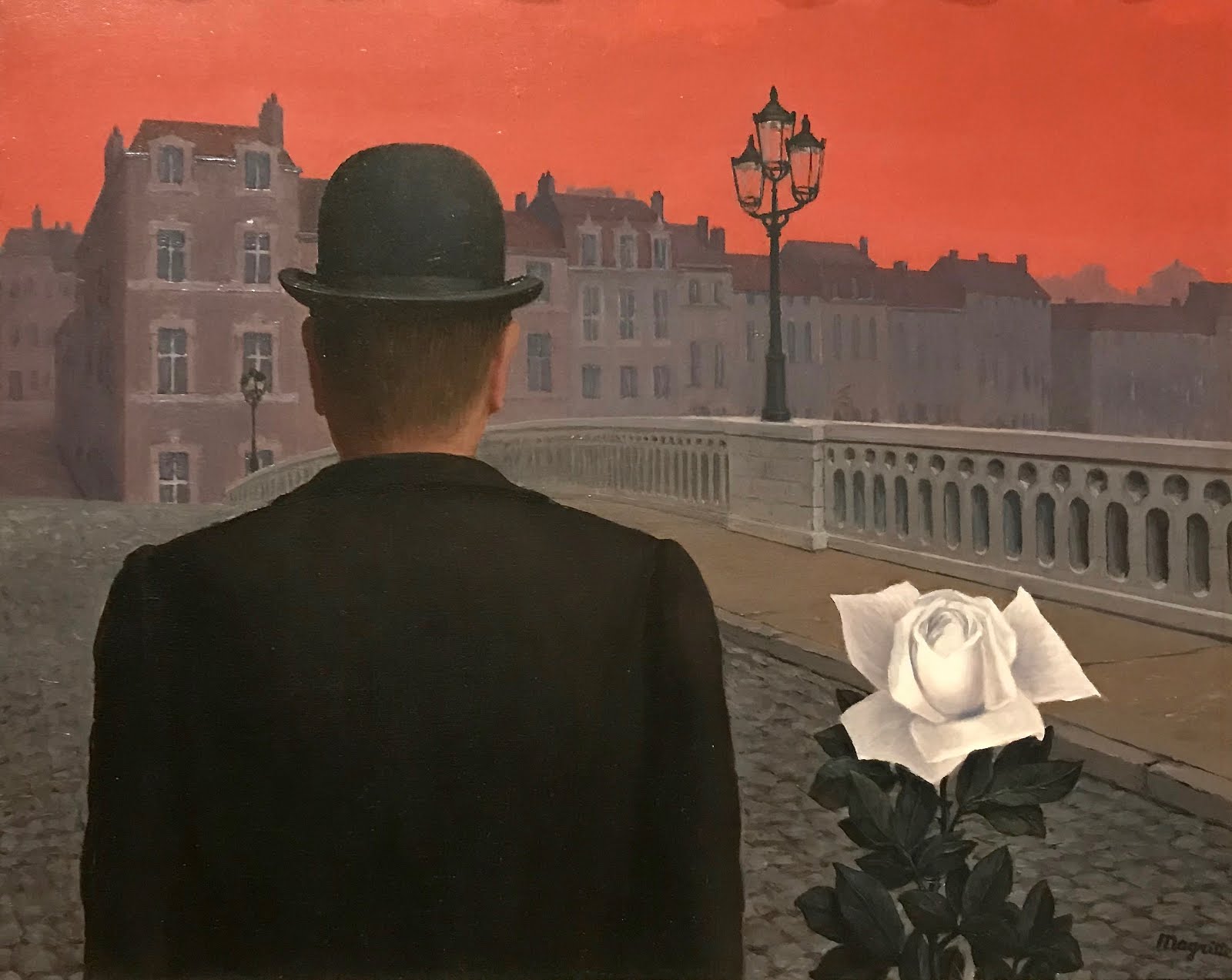
Pandora's Box, 1951
Pandora is a character in a Greek myth who unknowingly opens a jar left in her husband's care by Zeus, the most powerful of the gods. The jar contained sickness, death and many other unspecified evils, which were then released into the world. The jar was long ago mistranslated as a box. Magritte said of this painting, "The presence of the rose next to the stroller signifies that wherever man's destiny leads him, he is always protected by an element of beauty."

Personal Values,  1952
This humorous painting, which is owned by SFMOMA and frequently on view, is such an appealing puzzle that the mind can hardly settle down. We recognize a comb, a neatly made bed, a wooden match, a wine glass, a bar of soap, a mirrored armoire, and a shaving brush, but the proportions are comical, the walls give way to the sky, and we have a pesky reflection that can't be explained. Can we say that sleeping and dreaming, smoking and drinking, personal grooming and reflective thinking are some of the painter's personal values. Or is this just a silly joke. The painter wants to put you on the edge of understanding.

The Blow to the Heart, 1952
It doesn't take much interpretation to relate to this figure. A pink rose generally stands for love, and the sharp connection between a thorn and a dagger is easy to make. Whenever you let love into your life, you open yourself to the possibility of pain. Is this a general observation, or is Magritte reacting to something in his life? For instance, Magritte's mother tried to commit suicide several times and finally succeeded in drowning herself when he was 13.

The Enchanted Domain, 1953

The Enchanted Domain in place at the casino.
Internet grab.
In 1953 a fan of Magritte's commissioned him to decorate the walls of a grand circular room in his casino in the seaside town of Knokke, Belgium. Instead of painting directly on the walls himself—which is a specialized skill—he did a series of eight easel paintings that technicians could enlarge and place continuously around the room. This gave the artist a chance to create an enchanted world filled with his own metamorphic figures. This exhibit includes five of Magritte's paintings.


Can we say that the enchanted domain, or enchanted realm, is a world where nothing is what is seems to be? Where absurdity reigns supreme? Where the rules of rationality don't apply? Good setting for heedless gambling.

The Dominion of Light, 1954

One of Magritte's best known themes is a dark city street under a blue sky with puffy daytime clouds. It should be mentioned that the scene he saw from the windows of his own home was a neighborhood like this one. Also in far northern regions like Finland, where the sun never goes down, it is possible to see real scenes where the streets are dark while the sky is still light. Some of these paintings seem almost like that. 

The artist produced several variations on this theme, partly because it was popular, and partly because the idea fascinated him. In each one, the idealized sky is a different shade of blue, the arrangement of houses and street lamps and silhouetted trees is different, and the light effects in the dark half of the image vary. The exhibit included several of these, but a two is enough to get the point. 


If you have day and night at the same time, you have the whole day at once. And the best part of the night or the day is the light, which makes everything visible, or almost visible, and makes painting possible.

Euclid's Promenades, 1955
Once again we have a canvas on an easel in front of a window. The cityscape in the window, presented as the real thing, is just as much an illusion as the cityscape on the canvas within a canvas. And the confusion between illusion and reality is compounded by an optical illusion calling attention to the illusion that from a certain perspective, parallel lines do come together, just like the sides of a cone. Euclid was a Greek mathematician who is considered to be the founder of geometry. Space, like time, is arbitrary and relative.

Hegel's Vacation, 1958
Now that we're all familiar with the value of absurdity, at least from the songs of the Beatles—"I'm fixing a hole where the rain's comin' in, and stops my mind from wanderin'"—the juxtaposition of a glass of water and an umbrella draws an easy guffaw. Hegel was a 17th century German philosopher who proposed the idea of "absolute idealism," in which the dualisms, such as mind and nature, and subject and object, are overcome.

The Listening Room, 1958
 This gorgeous oversized apple looks trapped and wistful. From Genesis, apples have associations with temptation, with knowledge, and with evil. And what about this 'listening room.' Is the room listening to the apple? Is the apple there to listen to the ocean? Is listening a form of temptation?

The Anniversary, 1959
Now it's the boulder's turn to fill the room and gaze at the ocean. Taken at these gargantuan sizes, inanimate objects such as an apple and a rock, seem to assume awareness and feelings. The rock seems a little more at home than the apple, but it must long for a little breathing space. Is Magritte an animist? Does he see every natural object as living and aware? Or perhaps when an anniversary comes up he feels too large for his situation.

The Tomb of the Wrestlers, 1960
This poor rose is not only too large for its space, it is harshly lighted as though by an interrogator. How the title might be related stumps me; I comfort myself by remembering that Magritte was happy when he posed a problem that foiled the thought process.

Magritte was in his sixties in the 1960s, and his work reached its peak of popularity, with his images being adapted to commercial uses. He continued to be concerned with the nature of reality and the role of imagination and illusion. Many of his symbols returned in different formats.

The Great Family, 1963
Once again we have the cloud-filled silhouette of a bird in flight, this time rising out of the sea and into a stormy sky. Seabirds are at home with both the sea and the sky. The free spirit need not fear the threatening storm.

The End of the World, 1963
Once again we consider the view on a dark street, with buildings and trees, and a bowler-hatted head, are silhouetted against the sky. This time, however, the cheery daytime clouds and light is replaced by a dim and threatening sky. For a painter, the end of light is the end of the visual world.

A Sense of Reality, 1963
This time our beloved boulder is hovering over a serene landscape. Is the painter's sense of reality floating away?

We conclude with four paintings featuring a bowler-hatted man, or his silhouette, centrally framed, like a religious icon. The bowler-hatted man is generic and anonymous (none of the many images of him show a face), so he may stand for Everyman. However, Magritte himself dressed formally and wore a bowler hat, so he may have identified with the figure.

The Son of Man, 1964

This image illustrates the idea that behind every reality is another reality, or the truth is always hidden by illusion, and illusion is based on temptation. The artist offers his creations in place of himself.
The Granite Quarry, 1964
The tempting apple returns in a group of three, arranged on a granite wall by the sea. The silhouette of the bowler-hatted man is filled with both fluffy clouds and bright stars, with a crescent moon thrown in as well, against a pale, disappearing seascape. Dichotomies of night and day, organic and mineral, natural and spiritual come to mind. This figure is attending the mysteries inherent in reality.

High Society, 1965-1966
The bowler-hatted silhouette is filled with the familiar puffy clouds and peaceful seascape, and its shadow (!) is filled with a close view of foliage, suggesting a forest. The sea and the forest are good company, the highest form of society.

The Happy Donor, 1966
This time the bowler-hatted silhouette reveals a night scene, with a night sky. It is placed in front of a brick wall and accompanied by a bifurcated sphere, against a dull brown background. While the silhouette seems like a memory of home, the sphere has no corollary in the real world. The bifurcated sphere appears in many of Magritte's paintings, though only once in this group, and it never accumulates any meaning for me. Does the silhouette represent a happy donor? And what is it donating, anyway? It is donating mystery to life, or donating life to mystery.

Magritte died of pancreatic cancer in 1967 at the age of 68.  Year after year he made viewers question their assumptions about the nature of reality and the role of the imagination, and his influence is widely felt.

René Magritte with his bowler hat.


Sunday, July 8, 2018

Nathan Oliveira at Stanford

Through a serendipity of web browsing, I discovered that Stanford University has a meditation center called Windhover, and that Windhover, which is normally open only for the Stanford community, has a weekly Public Tour on Saturdays at 11:00 a.m., no fee and no reservation. I learned that the building has a unique, Japanese-influenced style, and that it is adorned by paintings by Nathan Oliveira, an important California painter who was also a long-time professor at Stanford. As a meditator myself, and an art hound as well, I felt bound to check it out.

My usual venues at the university are the art museums, which are some of the first buildings you reach from the town side of campus. Windhover is a half mile across campus from there, away from town, and no cars are allowed in the the central section of the campus. To approach by car, it would be practical to enter the campus from the other end, but I wanted to see what lies between the museum and the meditation center, so I parked in my usual spot in front of the museum (The A-permit lot there is open to the public on week-ends), and made the distance on foot. A half-mile jaunt is not a big deal, but it is noticeably uphill, and the temperature was way too hot to be outdoors. It was well worth the effort though because the campus is so beautiful. Ancient spreading oaks offered welcome shade along the route between noble sandstone buildings. Lawns, courtyards, and wading pools were occupied by young adults playing with scampering children. There could hardly be a lovelier vision of utopia.


Windhover is almost hidden—its presence is so muted. The sign at the entrance is transparent, cut into a sheet of iron. The entrance is hidden behind a dark wall and a long row of lofty bamboo, shielding it from the busy campus.


The building is low, and has glass panels in certain sections. I arrived early, so I had time to walk around to the reflecting pool on the far end, and to look inside the building. I saw a great red canvas on the wall, and on the floor, two students, lying prone. They squirmed when they noticed me, but were undeterred in their "meditation."


I sat on a stone bench by the tall wooden front doors and waited. After a few minutes, two other women arrived, one at a time, each asking about the tour. And then two tiny, bent elders shuffled up the long, bamboo-lined path to the entrance. The man fussed around the card-reader getting the doors opened up, while the woman introduced herself as Lucky, and asked our names. Then we entered the sanctum.

The first gallery has a window wall that looks out on the reflecting pool, another wall features one grand red painting, and the third wall is formed by a divider and a low dark water feature.


Lucky wasn't very authoritative or informative about the site; what interested her was to know what we saw when we looked at the grand red painting, with its radiating impasto and its two perfect arcs. Each of us noticed different things, and that led to some discussion and further looking.

However in the course of our time with Lucky, we gradually learned the story of how Windhover came to be. The meditation center was the dream of artist Nathan Oliveira, who taught studio arts at Stanford for over 30 years, from 1964-1996. Lucky and her husband, who slumped mutely on a bench, had known the painter and his wife, because Lucky's husband had also been a professor there; the wives had met through the Faculty Wives Club. It was an honor to meet someone who had been close to the artist and to the project of establishing Windhover.


Nathan worked in the art department's studio up on Dish hill, on the back side of the campus. It had great views and access to trails. He took regular walks, and the landscape inspired a suite of huge abstract transcendental paintings. He did this series late in life, and kept the paintings as aids to meditation. They are said to have been a source of comfort to him during the losses and sufferings of old age, and he dreamed of bestowing that peace upon the Stanford community in the form of a meditation center featuring these works as vehicles to a transcendent state, like mandalas.

The next room has two paintings. One is a diptych that is very wide, at least six times the width of his own outspread arms, and bears the image of spread wings soaring.


On another wall is a canvas one third that size that bears only an arc, trailing glory in the form of creamy, glowing impasto.


A glass wall looks out into a shady grove.


Passing down a long, glass-walled hallway, we came to the final gallery, where a disgruntled student sat cross-legged, facing the grove.


Another glass wall showed a small gravel-lined court with a modest, silently flowing water feature.


The huge painting in this space looks like dawn to me, the essence of universal dawn.


Like the meditation center, this suite of paintings is known as 'Windhover.' The title was suggested by a visitor to Oliveira's studio, an Irish poet, who was inspired by the paintings to recite a poem by Gerard Manley Hopkins by that title. Here's the first stanza:

I caught this morning morning's minion, king-
    dom of daylight's dauphin, dapple-dawn-drawn Falcon, in his riding
    Of the rolling level underneath him steady air, and striding
High there, how he rung upon the rein of a wimpling wing
In his ecstasy! then off, off forth on swing,
    As a skate's heel sweeps smooth on a bow-bend: the hurl and gliding
    Rebuffed the big wind. My heart in hiding
Stirred for a bird, – the achieve of, the mastery of the thing!

Hopkins' poem is obscure, but basically it is a tribute to a type of bird known as a Windhover in some places, but in northern California is known as a kestrel, which is a type of falcon. Oliveira's paintings had, in fact, been inspired by the flights of the kestrels and hawks seen from the trails near his home, and so he adopted that title for the suite, not giving titles to the individual paintings.

Lucky pointed out that there was a long-standing debate among fans and meditators about the pronunciation of Windhover, whether WINdhover or wind-hover. I thought the former the most common, but she pointed out that hover is more poetic: the kestrel hovers in the wind.

When I said good-bye to Lucky and the professor emeritus, and the two other visitors, I felt quite elevated and enlightened. A passerby with a bicycle advised me not to miss the meditation garden, so I walked around to the area that is visible from inside. There I found a magnificent pepper tree, probably original growth, guarding and keeping the meditation center, and nearby a meditation maze worked in tile on the ground.


From there I coasted comfortably downhill toward the Cantor Art Center, maneuvering between dark patches of deep shade and the cool outer hallways of massive sandstone buildings to mitigate the baking heat.


I headed straight for the Cool Café, the museum's order-at-the-counter eatery. Air conditioning, iced tea, and a juicy grilled chicken sandwich restored my strength.

I began to think about Nathan Oliveira again. I wanted to see examples of his usual work, which hadn't made a very big impression on me in the past. So I took a quick sprint around the upstairs gallery devoted to late 20th century and contemporary art. There I found one canvas.

Stelae #20, 1993
A stela is a stone memorial, so this image suggests overlapping grave markers, perhaps signifying a descent into death. This work from the 1990s is very late in the artist's career.

Making a final push, I went next door to the Anderson Collection at Stanford, where I discovered three more canvases by Nathan Oliveira.

Reclining Nude, 1958
This highly abstracted nude emerging from, or sinking into, obscurity, reminds us that Oliveira's reputation was originally as a member of the Bay Area figurative school, a group of painters who applied the techniques of Abstract Expressionism to the figure, as well as to landscapes and other subjects.  

Stage #2 with Bed, 1967
 After the bright and radiant images of Windhover, the dark palette of Oliveira's work in the 1950s and 1960s is shocking. This image of an empty stage in the dark seems to be a reference to death. Notice that in this work he uses a smooth, invisible brushstroke to create crisp lines and edges. 

Nude in Environment I, 1962
This colorful work depicts a female nude looking toward us from an inner world swirling with ideas and emotions, or so I surmise.

By this time, I was worn out. I didn't have the energy to do either the Anderson or the Cantor justice. I couldn't explore any more of the campus's wonderful gardens and architecture. I just needed to rest—and to meditate on my findings.

When I looked at my photos of Oliveira's work, I could see that my sample was too small to indicate the nature of his art. I was also surprised by the darkness of the vision they projected. So I did a little online research. When Oliveira died, in 2010, at the age of 81, the New York Times neatly summed up his career. The obituary says that he was influenced by the dark visions of European artists like Edvard Munch, Oskar Kokoschka, and especially Max Beckmann. He was committed to expressing the dark side of human emotions.

The obituary in Stanford News pointed out that Oliveira's father, a Portuguese immigrant, drowned in the Russian River when Nathan was young, a fact that seems to explain a lot. The article points out that Oliveira described his artwork with the Portuguese word saudade, a feeling of yearning and nostalgia.

Here are a few more significant examples.

Standing figure with Hands on Belt, 1960
from WikiArt
Standing Figure, 1970
from New York Times
Untitled - Figure Leaning, 1972
Watercolor and graphite on paper
from Berggruen Gallery
Ryan Figure #9, 1982
Oil on canvas
From Bergrgruen Gallery
Untitled Figure, 2010
from the Stanford News


Tuesday, June 19, 2018

Shadows and Fog

Shadows and Fog is a movie from 1991 that was written and directed by Woody Allen. It is available for rent on Amazon Prime.

In my opinion a work of art should be interpreted and evaluated on its own merits, as a unit, without reference to the biography of the artist and changing moral standards.

Shadows and Fog is a fascinating work of art composed of serious philosophical reflection, silly gags, cultural references, and special visual effects.

The movie considers all the Big Questions: what is the nature of reality, what is the meaning of life, what is our role in the larger universe, what is love, how is it different from lust, what is the value of marriage and family, what is evil and what causes it, what is the nature of political oppression and how does it work, does God exist, and, finally, what is the value of art. Barely a frivolous word is spoken in the movie, yet it is full of silly gags, jokes you might hear in vaudeville or melodrama.

The plot is generated by the problem of Evil, here personified by a homicidal maniac stalking the streets on foggy nights, and several murders are depicted with artful detachment. Overcome by fear and distrustful of the police, citizens have formed a vigilante committee, and they insist that Everyman join their cause.


Allen, the director, plays the nebbishy Everyman; he has been called to action by the Vigilante committee to combat Evil, but he can't figure out what to do or where to go. He seeks his way through a vague and undefined world symbolized by dense fog and evocative shadows.


Mia Farrow is Everywoman, who can swallow swords if need be, but wants only to raise a family.


John Malkovich is the Artist, who speaks for the creative life, and feels threatened by the demands of a family. He is a Clown, and his art is comedy. He says, significantly, "Nothing is more frightening than trying to make people laugh, and failing."

In the plot, the Sword Swallower and the Clown are part of a circus, where everything is an act, everything is an illusion, and reality is irrelevant.


Lily Tomlin plays the Whore with Heart, disillusioned and jaded, but broad-minded and generous. 


John Cusack plays the Smart Ass college student, who feels superior to everyone and doubts the value of everything.

In the plot, these two come together in a brothel, where Everyman and Everywoman also make an appearance. It is funny-ironic for characters to discuss love and marriage in a brothel.

One of the attractions of the movie is seeing so many well-known actors—a standard Hollywood ploy—in unusual guises.


David Ogden Stiers plays the Vigilante, who wakes Everyman from his sleep and demands that he join a plan to fight Evil, in the form of a maniac serial killer. 


Jodie Foster has a bit as a whore with fetching ringlets. 


Madonna plays a voluptuous acrobat. 

Much of the acting seems exaggerated, like the acting in a melodrama, because the actors are not playing 'real' characters, but roles in an extended existential joke.


Julie Kavner delivers a hilarious monologue as the Jilted Bride, eager to see Everyman dead because he humiliated her.


The key role of the Magician is played by a lesser-known actor named Kenneth Mars.

In the plot, the Magician saves the day—or at least foils the immediate danger—through the power of illusion; he captures the villain through trickery, or so it seems.

For art lovers, a major attraction of the movie is the look, composed of artful set design, stagey lighting, and very tricky cinematography. Some of the shots seem impossible. In one, the view goes from a closeup of a selfish Bitch standing in a second story window, pulls out to include back views of Everyman and Everywoman, moves clear around those two characters, and back up to the close-up in the window, without a cut. In another scene, the camera is in the center of a circle of Whores—talking about the role of illusion in creating sexual satisfaction—panning mechanically around, sometimes showing faces close-up, sometimes showing the woodwork and windows, just panning democratically around and around until Everywoman starts her lines, then it settles into extreme close-up, and our whirling feeling settles into attention.

Without getting into specifics, the score consists of clips of existing recordings. The music is circusy, discordant, old-fashioned, clanky. The melodies sound familiar but somehow off, inharmonious. This contributes to the carnival / whorehouse atmosphere, and the feeling that nothing is what it seems to be.

So, what is the meaning of all this melodramatic confusion? In the end the Artist discovers that family can be more satisfying than creativity, and so he agrees to settle down with Everywoman and make a family. Everyman finds his way at last by doing the thing he really loves. He apprentices himself to the Magician, ready to follow him at any price. Magic is defined as creating illusions, and symbolizes all the arts. If the universe is by nature chaotic and meaningless, the role of art is to make sense of things, to impose a temporary sense of order. Magic and Art satisfy the soul's quest for understanding and direction.

Monday, June 11, 2018

Gertrude Stein: Three Lives


Gertrude Stein's Three Lives is a literary masterpiece that everyone admires, and no one reads. Of those who do read it, few understand it. The reason is that it is innovative on many levels, and innovations have the big drawback of being shocking and disorienting.

The most shocking aspect is that the novel depicts women of the servant class with respect. The innermost lives of women who are generally overlooked and undervalued are studied with care and sympathy. The humble are raised up. In addition, Stein shows how being in service constricts their opportunity to develop a sense of self, and their lack of self-hood makes their lives futile.

The true subject of the novel is selfhood or authenticity; it's about free will and self-awareness. The three lives represent three unsuccessful stages of development of self-awareness, not culminating in fulfillment. Stein embodies these stages in fully-drawn characters, and then immerses these protagonists in detailed renderings of their social scene, peopled by vivid minor characters.

The first story is called The Good Anna. Anna represents the perfect servant, according to certain parts of the German-American community who adhered to old world traditions in the early 1900s. She devotes herself to service, both in her job and in her private life. She lives by an elaborate set of rules and strives to control everything around her.

Anna's life story is told through her relationships with others. We learn the complete life histories of her dogs, and we meet the under-servants that she scolds constantly, but her principal relationships are with her employers. First there's Miss Mary Wadsmith, "a large, fair, helpless woman, burdened by the care of her brother's two children." She manages that household for several years, until the girl gets married. Then Anna goes to work for Dr. Shonjen, a jovial bachelor doctor. When he gets married to a social-climbing woman, Anna goes to work for Miss Mathilda. This was the happiest period in Anna's life:

  • With Miss Mathilda Anna did it all. The clothes, the house, the hats, what she should wear and when and what was always best for her to do. There was nothing Miss Mathilda would not let Anna manage, and only be too glad if she would do.

Anna's only family is a half-brother, a wealthy fat baker, and his sharp-tongued wife. Anna does her duty, as she sees it, by their family, but she doesn't really care about them, nor they about her.

The romance in Anna's life is Mrs. Lehntman, a widow who supports her two children by working as a midwife. Anna is entirely "subdued by her magnetic sympathetic charm." Romance, Stein explains, is the ideal in one's life. The way this plays out is that Anna helps Mrs. Lehntman in all her endeavors—especially tending to poor young girls who are pregnant and alone. The two remain friends for many years, though Anna disapproves of some of her friends' actions and gradually gains a more realistic attitude toward her.

Anna's other friends are all needy and dependent. She spends all her spare income helping people who are sick, who have bad luck, who are too ignorant to care for themselves, who long to follow their dreams. She makes no effort to plan for her own future or to care for her own health.

Anna complains constantly about the failure of the people in her life to meet her high standards of behavior, but generally she finds both success and contentment in her work as a servant. But service is the only way of relating to people that she understands, and it is the basic rule of her life. When she comes to a point in her life when she can no longer work as a servant, she opens a boarding house, and basically works herself to death in the service of the poor young men who live with her.

All of Anna's employers and friends urge her to take better care of herself, but Anna is not really aware of herself. That is the problem: no sense of selfhood.


The third story is called The Gentle Lena. Lena represents a person who is totally lacking in self-determination; she is a good girl, meaning a good maid who does as she is told without complaining. Her passivity causes her to be pushed about; her lack of will or self-assertion condemns her to a short, unhappy life, ending in gray and miserable dissolution.

Stein represents Lena's sweet and gentle nature in a lovely passage:
  • Lena's german voice when she knocked and called the family in the morning was as awakening, as soothing, and as appealing, as a delicate soft breeze in midday, summer. She stood in the hallway every morning a long time in her unexpectant and unsuffering german patience calling to the young ones to get up. She would call and wait a long time and then call again, always even, gentle, patient, while the young ones fell back often into that precious, tense, last bit of sleeping that gives a strength of joyous vigor in the young, over them that have come to the readiness of middle age, in their awakening.
When we first meet her, Lena's life is an easy routine of housework and childcare, with an "unexacting mistress," and she is fairly content.

But Lena totally lacks will or self-determination:
  • Lena always saved her wages, for she never thought to spend them, and she always went to her aunt's house for her Sundays because she did not know that she could do anything different.
Several times, the author describes her with this phrase:
  • She was always sort of dreamy and not there.
Her downfall starts when her bossy aunt succeeds in marrying her to an unaware gay man named Herman who appears to be as bland and obedient as she is, despite the fact that neither wants to marry. Herman is a tailor. He works for his father and lives with his parents in the house next door. Though the family is prosperous, they are stingy with money and lax in their grooming.
  • Lena began soon with it to look careless and a little dirty, and to be more lifeless with it, and nobody ever noticed much what Lena wanted, and she never really knew herself what she needed.
The worst part of living with Herman's parents is that his mother harangues Lena constantly for not having their same stingy ways. Lena has no reassuring contact with old friends, who might come to her defense. Always dreamy, she becomes ever more absent and dull. When she gets pregnant, she is paralyzed with fear and sickness.

The only way Lena gets any relief is through the help of an old cook who intervenes on her behalf and starts a process that leads to Lena and Herman getting a separate house after the child is born. But neither having her own place nor motherhood is enough to lift her out of her despair.
  • This did not seem to make much change now for Lena. She was just the same as when she was waiting with her baby. She just dragged around and was careless with her clothes and all lifeless, and she acted always and lived on just as if she had no feeling. She always did everything regular with the work, the way she always had had to do it, but she never got back any spirit in her.
Herman's sense of self is awakened by his strong desire to be a father, and the pair have two more children. Herman takes over the care of the children, while Lena becomes more and more lifeless.

Lena's fourth baby is still-born, and she dies giving birth as well. Except for the 'good german cook,' no one cares. In fact, now Herman can raise his family without having to worry about her.


These two stories serve as book-ends or supports for the central story, Melanctha. Melanctha is a seeker. She says she wants to know the world, but what she is really looking for is unconditional love, expressed as unbridled passion. When you dig down into the depths of this story, you learn that she was unloved in childhood, both by her pale, ineffective mother and her absent brute of a black father. A psychologist might say that she never learned to love herself because her parents didn't show her much love. Early in childhood, she developed a cheery and helpful personality that hid her emotions and prevented her from making authentic contact with people. No one can ever love her enough to make up for her parents' neglect.

While Stein makes women from German culture represent suffocating tradition, she reaches into the African-American community to create a character on a quest. Her father is black, but her mother is described as a pale yellow colored woman. Stein makes much of the fact that Melanctha is half-white. Her personality combines the stereotypical attributes of the two races: smart and articulate like white people; passionate and wild like black people, all this according to the stereotypes of the time.

When we first meet Melanctha she is in high school and just beginning to explore the world of men. When she gets out of school, she doesn't seek employment. Just how she gets by is not explained, except to say that occasionally she does a little sewing for people. She spends more and more time hanging about with men; while she might not be hooking, she might be receiving various favors from admirers that help her get by. None of this is stated. Her circumstances are not important to the story. The story that Stein wanted to tell was about her inner life.

After a lot of romantic and sexual adventure, described in very vague terms, Melanctha rises to the point of engaging in a romantic relationship with a serious and virtuous doctor from the black community. The development, culmination, and decline of their romance is rendered with greater intimacy than any other fictional romance I know: we see exactly what Melanctha and the doctor think of each other at each stage of the process. From the beginning, they argue about authenticity. Doctor Jeff is a thinker, and has a lot of ideas about virtuous living that he likes to expound. Melanctha accuses him of ignoring his own principles; she says his behavior is not so virtuous as he likes to think. On the other hand, Doctor Jeff doesn't quite trust Melanctha; she always seems to be holding something back.

Despite these initial misgivings, the two are attracted to each other. Melanctha grows to like Doctor Jeff's warm and generous ways. Jeff is attracted by her beauty and her ability to articulate her thoughts, and he is charmed by the sympathetic way Melanctha listens to his incessant ruminations. Melanctha begins to hope he can make her feel secure. Their earliest conversations seem to be very authentic, each one expressing their truth sincerely. Stein allows them months of blissful wandering in nature and enjoyment of each other's company.

But there is a fly in the ointment, and that is the original question of authenticity. At the peak of their bliss, Melanctha does something, just some random gesture, that reminds Jeff of her other life, her life with other men, the world she doesn't talk about while she is listening to him so demurely. And in fact, Melanctha is not quite satisfied with Jeff either; she still thinks he is out of touch with his emotions; she secretly thinks he is sort of a wimp, but she has been submissive because she wants to please him. Stein depicts every step in the unwinding of their relationship. In the course of their arguments, they seem to cover every aspect of the search for authenticity that any psychologist ever identified, though they use everyday language, and are not sure themselves just what they are talking about.

Doctor Jeff drives himself crazy with too much thinking, but eventually he figures out that he was right all along. He rejects Melanctha's claim that he is hypocritical and inadequate; he rejects her neediness that manipulates him into expressing more than he feels; he rejects her inability to talk about her past life. He sees that some place along the way, she quit talking to him sincerely like an equal, and started putting on an act in order to bind him to her. Slowly and painfully, Doctor Jeff backs away, and resumes his quiet, virtuous life.

Melanctha, on the other hand, is unable to learn from the experience. She doesn't quite achieve a level of self-awareness that would enable her to learn from her mistakes; she is all instinct, driven by unquenchable psychological needs.  Generously, Stein allows her to meet the man of her dreams and to have the perfect all-encompassing romance, for awhile; but the man is a gambler, and when his luck runs out, his love fades as well. Players only love you when they're playing.

The strongest character in Melanctha's life is Rose Johnson. Rose is described as careless, negligent, and selfish, but she is completely authentic: she always knows what she wants, she always has an idea of how to behave to get what she wants, she always has faith in herself. Melanctha becomes more attached to Rose than to any of the men in her life, and will demean herself with any sort of service in order to be with her. But even Rose eventually rejects her. She too becomes concerned about Melanctha's other life, her secret interactions with unspecified men. She hates that Melanctha's self-defeating behavior patterns. She gets sick of her simpering submissiveness, hiding a wild and promiscuous personality. She totally disdains Melanctha's whimpering threats to end her own life.

Stein handles the rest of Melanctha's life in summary fashion. She gets very sick, with consumption or something; she gets well after long treatment. She takes an actual job as a servant, and attempts to live a quiet regular life, but her health is compromised, and she dies young. Sad story.

An aspect of the novel that sounds harsh to the modern ear is Stein's use of stereotypes in building her African-American characters, including the use of the word 'nigger.' However, you notice that she uses positive as well as negative character types, and she makes each character rise above type into eccentricity and particular traits. Moreover, her German characters are all stereotypes as well. All the characters conform to some known type, but the way they talk and the details of their lives are highly individualized and convincing.


On top of innovations in subject, theme, and structure, Gertrude Stein invented her own writing style, an elusive style that sometimes serves as a barrier because people reject its lack of conformity. The most obvious feature is repetition—repetition of descriptive phrases, sentences and whole paragraphs. Characters may be described with the same phrase in one situation after another, but each time that phrase relates to new phrases. She treats phrases like shapes that can be repeated in different parts of the picture. Whole anecdotes might be told in the beginning and repeated at the end of a story. For instance, Melanctha's story opens with an event in a friend's life: Rose Johnson has a hard time with her baby. That anecdote is repeated toward the end of Melanctha's story, after we learn a lot about Rose and Melanctha.

This aspect of Stein's style has been compared to Cubist painting, because it looks at a subject from different angles, and builds up a picture from layers. Repetition of phrases, sentences, and paragraphs also makes it sound like music; repetition is like the chorus in a song. These stories sound a little like long ballads.

For the critics of Stein's time—who were steeped in the stilted prose of the 19th century and enthralled by the elaborate sentences of Marcel Proust and James Joyce—the ordinary, everyday quality of Stein's language and sentence structure must have seemed primitive. Stein's vocabulary is about 6th grade level, maybe lower, the type of words used by the servant class. The most complex psychological concepts are alluded to vaguely by everyday words, vernacular speech for German maids and women in the lower levels of the black community.

Stein also minimized punctuation: no colons or semi-colons, only commas allowed, and only when really necessary. Similarly, no capitol letters: she refers to 'german' girls.

More remarkable, Stein doesn't use subordinate conjunctions, like 'although' or 'since', to show relationships between facts or ideas. She tends to string simple sentences together with 'and,' piling up details one at a time. Nor does she use a lot of modifying prepositional phrases, such as 'despite her reluctance…' The result is, the novel can be read very rapidly; it sounds like ordinary conversation. Stein's style is so fluid that she moves in and out of the thoughts of various characters without the reader noticing the changes from one to another. If you let down your resistance, the novel sounds like a long sad song cycle.

Three Lives is a hard book to put down. It sort of seeps into your soul.