Thursday, May 12, 2016

The 5 Big Stars of the New SFMOMA

The biggest event in the Bay area art scene in the past few years was the 100-year loan by Donald and Doris Fisher, founders of the Gap clothing stores, of their renowned collection of art from the last half of the 20th century to the San Francisco Museum of Modern Art. The Fishers had originally dreamed of building their own museum in the Presidio, but the officials at the Presidio were not keen on new, modern, buildings, whereas Director Neil Benezra of SFMOMA offered to partner with the Fishers to add an exciting new wing to the museum where their collection could be handsomely exhibited.

The museum has been closed for three years—long, tedious years for fans of modern art—for the $305 million addition. The work is finishing up now, the collection is in place, and preview days are being given to "charter" members, that is members who continued paying dues during the dark period, like myself and Dan. The new museum opens officially May 14.

We were eager to see what the new building was like, of course, but our major excitement was to experience the Fisher collection, and to understand why it is so highly valued.

The Fisher Collection

The Fisher collection is rooted in blue-chip work of the white male art world of 1960s America and Germany. It compliments the museum's regular collection, since it has many of the same artists. For the opening, the Fisher collection is shown intact, so you will encounter the same artists in two different locations. In the future, the museum will be able to show all the works by the same artist in the same galleries. You can appreciate an artist better when you can see many of their works at the same time. The work of several of my favorite artists is presented in great depth.

The examples below—my own iPad photos—are from the Fisher collection, unless otherwise noted.

Wayne Thiebaud, born 1920

California artist, Wayne Thiebaud, is still working at age 96. Whether he is painting sweet treats or steep streets, flat rivers or towering canyons, demure students or frank nudes, Thiebaud makes it all look delicious, if slightly out of reach. Early in his career, he preferred blunt, straight-on compositions, but later he exploited unusual, if not impossible, perspectives.
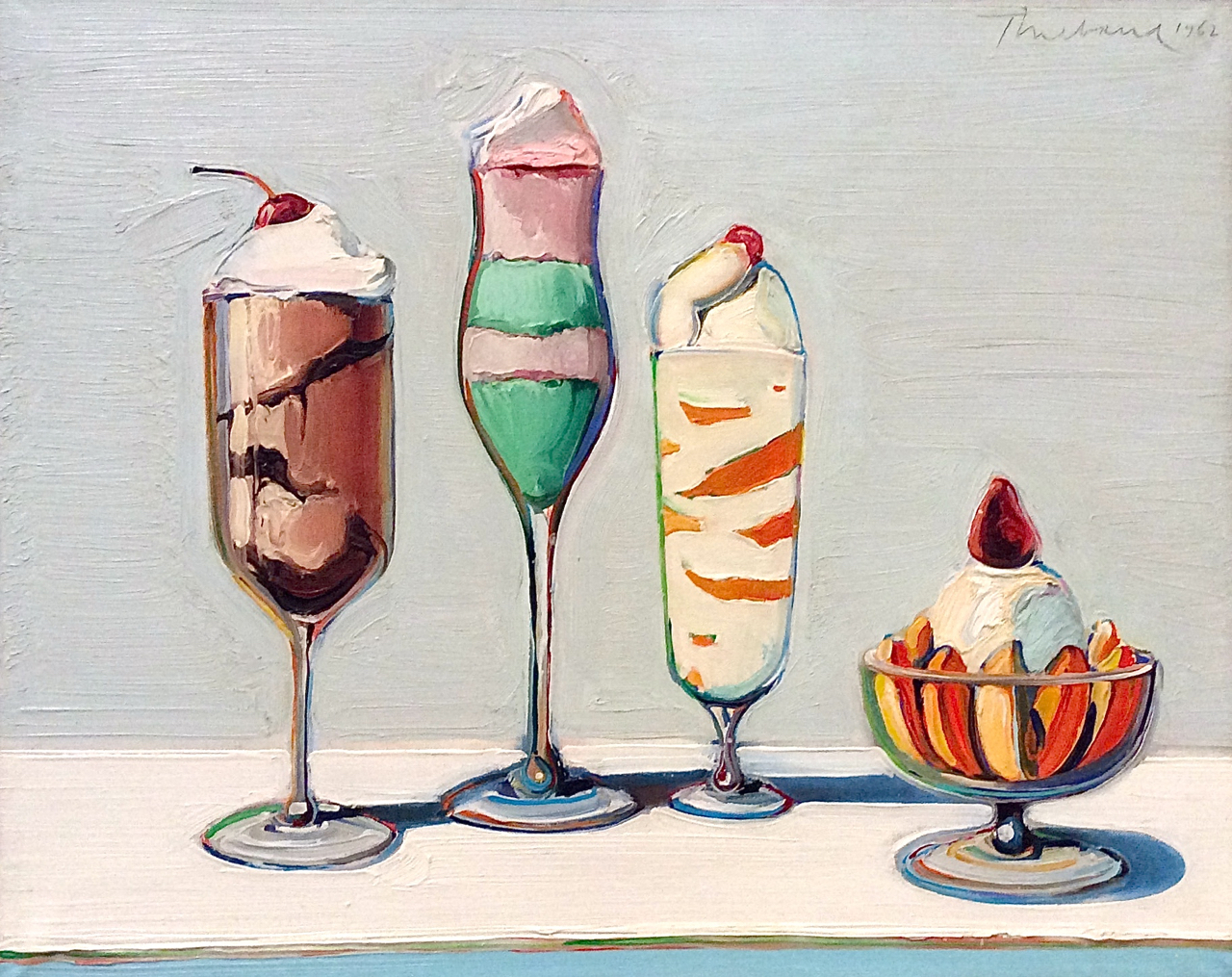
Wayne Thiebaud, b. 1920
Confections, 1962
SFMOMA's regular collection
Wayne Thiebaud, b. 1920
Student, 1968
Wayne Thiebaud, b. 1920
Girl with a Pink Hat, 1973
Wayne Thiebaud, b. 1920
Sunset Streets, 1985
Wayne Thiebaud, b. 1920
Flatland River, 1997
Wayne Thiebaud, b. 1920
Valley Streets, 2003
Wayne Thiebaud, b. 1920
Canyon Mountains, 2012

Ellsworth Kelly, 1923-2015

New Yorker Ellsworth Kelly, who just died this past December, was the ultimate minimalist. Minimalism is an approach to art that aims to produce maximum impact with limited means. Kelly confined art to explorations of primary colors and simple geometrical shapes, and the interaction between them. He gave the results importance by making them large and imposing.

The following examples are from a series of multi-panel works from the Fisher collection.

Ellsworth Kelly, 1923-2015
Red Green, 1968
Ellsworth Kelly, 1923-2015
Black Triangle with White, 1976
Ellsworth Kelly, 1923-2015
Yellow Relief with Black, 1993
Ellsworth Kelly, 1923-2015
Red Curves, 1996
Ellsworth Kelly, 1923-2015
Red on Red, 2001
Sometimes he created shaped "canvases" from wood or bronze.

Ellsworth Kelly, 1923-2015
Curve XXI, 1978-1980
Ellsworth Kelly, 1923-2015
Untitled (Mandorla), 1988
SFMOMA regular collection

Here are two irresistible color experiments from early in his career that are part of the museum's regular collection.

Ellsworth Kelly, 1923-2015
Spectrum Colors Arranged by Chance, 1951-53
SFMOMA regular collection
Ellsworth Kelly, 1923-2015
Spectrum I, 1953
SFMOMA regular collection

Gerhard Richter,  born 1932

German artist Gerhard Richter has three completely different modes. One is to paint blurry copies of photographs, whether portraits, objects, or scenes. The second is to create intensely contrasting abstractions using various devices to scrape the paint into layers. The third is to experiment with color in a flat, impersonal manner.

Gerhard Richter, b. 1932
Cityscape Madrid, 1968
Gerhard Richter, b. 1932
Two Candles, 1982
Gerhard Richter, b. 1932
Seascape, 1998
Gerhard Richter, b. 1932
The Reader, 1994
SFMOMA regular collection
Gerhard Richter, b. 1932
Janus, 1983
Gerhard Richter, b. 1932
Abstract Painting, 1992
Gerhard Richter, b. 1932
256 Colors, 1974/1984
Gerhard Richter, b. 1932
Mirror, Blood Red, 1991
Gerhard Richter, b. 1932
Strip,
2012
SFMOMA regular collection

Chuck Close, born 1940

New Yorker Chuck Close paints only faces. He first became known for large-scale, photorealistic portraits using pencil or watercolor.

Chuck Close, b. 1940
Gwynne, 1982 
Then he began experimenting with different media, such as fingerprints made from an ink-pad.

Chuck Close, b. 1940
Phyllis, 1981
To transform photographs into massive images, Close uses a grid system. Gradually, he began focussing on the grid itself, treating each cell as a design element.

Chuck Close, b. 1940
Lorna, 1995
This portrait depicts Close's friend Roy Lichtenstein.

Chuck Close, b. 1940
Roy I, 1994
This portrait shows artist Agnes Martin, whose work the Fishers also collected.

Chuck Close, b. 1940
Agnes, 1998
In the 21st century, Close has made wall-size tapestry portraits, composed of thousands of combinations of woven colored thread.

Chuck Close, b. 1940
Lorna, 2006
It should be noted that Chuck Close became a star despite several handicaps. In addition to being dyslexic, he has a rare condition that makes him unable to recognize faces—hence his obsession. In 1988, after he was already a celebrated artist, Close had a seizure that left him paralyzed from the neck down—spinal artery collapse. Although he has regained a small degree of mobility in his limbs, the brush must now be taped to his arm, and he relies on an assistant to create the grids for his paintings and to manipulate the position of the canvas. If anything, his work has become even more interesting.

Anselm Kiefer, born 1945

German painter Anselm Kiefer is concerned with the history and culture of his country, and dwells on scenes of destruction and loss in wall-size paintings that often incorporate materials such as straw, ash, clay, lead, and shellac. He also does sculptural installations on the same themes.

Anselm Kiefer, b. 1945
Margarethe, 1981
Anselm Kiefer, b. 1945
Wayland’s Song, 1982
Anselm Kiefer, b. 1945
Sulamith, 1983
Anselm Kiefer, b. 1945
Operation Sea Lion, 1983-84
Anselm Kiefer, b. 1945
Melancholia, 1991

The Big Five

Who was that again? In chronological order.

Wayne Thiebaud is a California artist whose style is realistic with romantic overtones.

New Yorker Ellsworth Kelly was the ultimate minimalist painter.

German artist Gerhard Richter does blurry paintings of photographs, scraped paintings with intense colors, and detached color experiments.

American Chuck Close paints only faces, usually on a very large scale, in a variety of techniques.

German Anselm Kiefer dwells on scenes of destruction using natural materials such as weeds and lead.

Now when you visit SFMOMA, instead of saying, "Huh?" you can say, "Oh sure. I recognize his style."

Women in the Fisher Collection

Although the Fisher collection has many impressive holdings, it doesn't earn any points for diversity or adventurousness. The only woman artist shown in depth is a minimalist named Agnes Martin. Several of her meditative works are exhibited in a hexagonal room, where they create a sort of temple of serenity.

Agnes Martin, 1912-2004
Night Sea, 1963
Agnes Martin, 1912-2004
Drift of Summer, 1965
Agnes Martin, 1912-2004
Untitled #9, 1995
Works by only three other women from the Fisher collection are exhibited in the opening show.

Joan Mitchell, 1925-1992
Harm’s Way, 1987
Lee Krasner, 1908-1984
Polar Stampede, 1960
Pat Steir, b. 1938
Three Pointed Waterfall, 1990
Women Artists in the Collection of SFMOMA

Fortunately, SFMOMA's regular collection includes paintings by several other women.

Possibly the greatest portrait painter of the 20th century was Alice Neel. Although Chuck Close depicted faces, he didn't do character studies, in the tradition of Rembrandt, for instance. Neil's portraits are notable for their expressionistic use of line and color and their insight into character.

Alice Neel, 1900-1984
Geoffrey Hendricks and Brian, 1978
American Dorothea Tanning, who lived to be 102 years old, had formidable creativity that expressed itself in sculpture and poetry as well as in painting. Her early painting style was influenced by Surrealism. The painting below expresses a common feeling for people whose consciousness is expanding.

Dorothea Tanning, 1910-2012
Self-Portrait, 1944
Bay Area artist Jay DeFeo is associated with Beat Generation artists. In her characteristic works she used thickeners to give the paint the texture and malleability. She used palette knives and other tools to sculpt it into a dramatic shape. This example emulates the swirl of a cape used in a bull fight.

Jay DeFeo, 1929-1989
The Verónica, 1957
Another Bay Area artist associated with the Beat Generation is Joan Brown. Her work was entirely figurative and autobiographical, but her style was constantly evolving. She swam in San Francisco Bay daily, and was especially proud of having swam to Alcatraz. Her paintings are frequently about swimming.

Joan Brown, 1938-1990
After the Alcatraz Swim 1, (1975)
Vija Celmins was born in Latvia, but immigrated to the United States with her parents when she was 10 years old. She is known for photorealistic paintings of natural environments.

Vija Celmins, b. 1938
Night Sky #16, 2001
Hung Liu was born in China during the Maoist regime, and came to the U.S. in her mid-30s to attend UC San Diego. She currently lives in Oakland, and her works may often be seen in Bay Area museums. Her paintings are generally based on historical Chinese photographs and treat the loss of a way of life of everyday people.

Hung Liu, b. 1948
The Botanist, 2013 
Dana Schutz is a young American who uses an audacious palette and tension-filled humor to create unique images loaded with symbolic possibilities.

Dana Schutz, b. 1976
Ear on Fire, 2012

Modern and Contemporary Sculpture

The Fisher collection also includes several masterpieces of 20th-century sculpture. Combined with SFMOMA's regular collection, the museum is now able to show a fairly complete survey of sculpture in that century. The following examples come from both collections, as noted.

Sculptors adopted abstraction more readily than painters. It seemed natural to create whole new forms instead of laboring to imitate reality.

Women sculptors of the 20th century were so bold and ingenious that the art world was less concerned with their gender than in painting.

The first important abstract sculptor was Englishman Henry Moore. In the first half of the century his works dominated the museum landscape.

Henry Moore, 1898-1986
Working Model for ‘Oval with Points,’ 1969
Fisher Collection
His close contemporary, Barbara Hepworth, also an English artist, explored some of the same problems with her work. It has taken her work a longer time to build a reputation, but it is now common to see at least one example in important collections of modern art.

Barbara Hepworh, 1903-1975
Sphere with Inner Form, 1963
Fisher Collection
In America, the most recognizable name in 20th century sculpture is Isamu Noguchi, who was born in Los Angeles, but whose father was Japanese. He was working in a similar abstract tradition to Moore and Hepworth, with more respect for natural materials and more spontaneity.

Isamu Noguchi, 1904-1988
Shodo Flowing, 1959
Fisher Collection
Isamu Noguchi, 1904-1988
Cronos, 1947-1964
SFMOMA Collection
Isamu Noguchi, 1904-1988
Samothrace, 1984
Fisher Collection
American sculptor Beverly Pepper has used so many different styles and materials that it is difficult to recognize her style, which is one reason her name is not better known. In the past few decades most important collections of modern sculpture have at least one of her works. The Fishers collected one that developed in Noguchi's direction.

Beverly Pepper, b. 1924
Tarquinia Cone Column, 1981
Fisher Collection
West Coast icon Ruth Asawa turned sculpture on its head. Instead of carving, modeling, or using a mold to make a form, she built shapes from wire. Her forms continued in the same abstract tradition, but she arranged them so as to include their shadows in the whole.

Ruth Asawa, 1926-2013
Untitled (S.046abcd), c. 1960
Collection of SFMOMA
Ruth Asawa, 1926-2013
Untitled (S.114, Hanging, Six-Lobed Continuous Form with a Form), c. 1960
Collection of SFMOMA
Minimalism hit sculpture with terrific impact, and it dominates the Fisher Collection. Minimalism in sculpture has to do with simple, geometric shapes, often in repeated patterns. The materials are usually interesting in themselves, and the manufacture is usually very refined. The perfect example of this is the work of American sculptor Donald Judd. This one is made of copper and plexiglas. It's hard to keep your hands off it.

Donald Judd, 1928-1994
Untitled, 1988
Fisher Collection
Dan Flavin, an American sculptor, added two radical ideas to minimalist sculpture. By working exclusively with regular fluorescent bulbs, he introduced the idea of using standardized industrial units as well as using light to create form.

Dan Flavin, 1933-1996
the diagonal of May 25, 1963
Collection of SFMOMA
Dan Flavin, 1933-1996
“monument” for V. Tatlin, 1969
Fisher Collection
Dan Flavin, 1933-1996
untitled (to Barnett Newman) two, 1971
Collection of SFMOMA
American minimalist sculptor Carl Andre is easy to overlook because his work might lie right on the floor or hide in a corner. It doesn't offer color to make a splash; it doesn't use luxury materials. The forms it takes are abstract ways of defining space. The Fishers collected several of his pieces.

Carl Andre, b. 1935
Copper-Zinc Plain, 1969
Fisher Collection
Carl Andre, b. 1935
Belgica Blue Tin Raster, 1990
Fisher Collection
Carl Andre, b. 1935
13th PbFe Triangle, 1987
Fisher Collection
Carl Andre, b. 1935
9th Cedar Corner, 2007
Fisher Collection
Carl Andre, b. 1935
Furrow, 1981
Fisher Collection
Minimalism is way too rigid for artists like American sculptor Mark di Suvero. He is interested in applying the wild freedom of abstract expressionism to sculpture. He complicated the problem by using rough materials, like left-overs from a construction project. This in turn created some tricky problems in balance.

Mark di Suvero, b. 1933
Che farò senza Eurydice, 1959
Collection of SFMOMA
Balance was also a major interest of American sculptor Richard Serra. Early in his career he produced exercises in balancing heavy materials, without apparent concern for aesthetic effect. This is a type of Minimalism.

Richard Serra, b. 1938
Floor Pole Prop, 1969
Fisher Collection
Richard Serra, b. 1938
House of Cards, 1969/1978
Fisher Collection
Richard Serra, b. 1938
1-1-1-1, 1969/1986
Fisher Collection
In the 21st century Serra began working with curved forms on a huge scale. Balance is still important because these rolled steel structures are free-standing; only certain geometrical shapes can maintain stability. The totally new factor is that the shapes are so large you can walk in them, and experience space in a whole new way. Serra is as concerned with shaping space as with shaping steel.

Richard Serra, b. 1938
Sequence, 2006
Fisher Collection
Another artist who plays with balance is American sculptor Joel Shapiro. He composes forms out of rigid beams, but somehow they playfully evoke the humanoid.

Joel Shapiro, b. 1941
Untitled, 1989
Collection of SFMOMA
English sculptor Richard Long represents a whole new way of thinking about sculpture, generally known as 'land art.' In general these artists use materials directly from nature, selected and arranged in an aesthetic form. Although Long's art takes various forms, in museums, it is generally shown as circles composed of similar natural stones. Sometimes a museum will commission a work from stone that is local to the area.

Richard Long, born 1945
Autumn Circle, 1990
Fisher Collection
The only work by a black artist that was shown in the opening exhibit of the Fisher Collection  was a sculpture by Martin Puryear. However, SFMOMA has a long-standing commitment to Puryear, so they complemented the Fisher piece with two from their regular collection. The unique element about his style is his concern for hand craftsmanship Notice that these works are from the 21st century.

Martin Puryear, b. 1941
Two Plus Seven, 2004
Collection of SFMOMA
Martin Puryear, b. 1941
Title unrecorded
Collection of SFMOMA
Martin Puryear, b. 1941
Malediction, 2007
Fisher Collection
One of the most extraordinary contemporary sculptors is Anish Kapoor, who was born in Bombay but has lived and worked in London since his twenties. His works frequently feature distorted reflections and perceptual illusions. When you look at the next piece straight on it appears flat; from an angle you see a black hole.

Anish Kapoor, b. 1954
Vortex, 2004
Collection of SFMOMA
Anish Kapoor, b. 1954
Vortex, 2004 (detail)
But where are all the people? Some sculptors stubbornly pursued the figure in the 20th century despite the dominant trend toward abstraction, but instead of carving or modeling free-hand, they tended to use some complicated technique to apply a mold directly to the subject. George Segal deliberately left his figures crude and artificial, while giving them 'real' settings.

George Segal, 1924-2000
Woman Shaving Her Leg, 1963
Fisher Collection
By contrast, Duane Hanson finished his figures with such detail that museum visitors sometimes assume they are real people, and stroll right by them. This model for the next example was the artist's own son.

Duane Hanson, 1925-1996
Policeman, 1994
Fisher Collection
Duane Hanson, 1925-1996
Policeman, 1994
Fisher Collection
Los Angeles-based artist Charles Ray used ultra-realistic modeling for the next work, but he elevated the subject by rendering it in polished stainless steel. The homeless sleeper may be a permanent fixture, but she has a kind of dignity of her own.

Charles Ray, b. 1953
Sleeping woman, 2012
Collection of SFMOMA
Charles Ray, b. 1953
Sleeping woman, 2012
Collection of SFMOMA
One of the biggest names among women sculptors is Kiki Smith, an American artist whose work tends to treat the roles women play. Her forms vary, but she typically uses real figures in symbolic situations. This example is benignly realistic except for the outsize head and slightly compressed modeling.

Kiki Smith, b. 1954
Guard, 2005
Collection of SFMOMA
English sculptor Marc Quinn is interested in the contemporary practice of people creating their own look and using their skin as a canvas for a personal statement. This example is molded from concrete.

Marc Quinn, b. 1964
Zombie Boy (City), 2011
Collection of SFMOMA
Marc Quinn, b. 1964
Zombie Boy (City), 2011 (detail)
Collection of SFMOMA
Another British sculptor, Antony Gormley, used metal bars to create a human figure that expresses the way sub-atomic particles and energy that make up our bodies is integrated with those that compose the universe around us.

Antony Gormley, b. 1950
Quantum Cloud VIII, 1999
Fisher Collection
Another group of sculptors re-created or re-used real objects with some sort of symbolic distortion. Claes Oldenburg and Coosje van Bruggen generally recreated common objects on a massive scale.

Claes Oldenburg and Coosje van Bruggen
Inverted Collar and Tie — Third Version, 1993
Fisher Collection
Claes Oldenburg and Coosje van Bruggen
Geometric Apple Core, 1991
Fisher Collection
Sherrie Levine, an American artist who is better known for photography, created a urinal from bronze. This is a reference to a famous Dada art trick in which Marcel Duchamp exhibited an ordinary urinal as a work of art, as a sort of snub to the art world establishment.

Sherrie Levine, b. 1947
Fountain, After Marcel Duchamp, 1991
Collection of SFMOMA
American artist Jeff Koons—infamous for his massive chrome-plated balloon-dogs—created a perfect bouquet of wooden flowers. Koons' work is generally about realizing popular dreams and raising ordinary pleasures to high art.

Jeff Koons, b. 1955
Large Vase of Flowers, 1991
Collection of SFMOMA
Chinese dissident artist Ai Wei Wei made an aesthetic statement by dipping ancient Chinese clay vessels in modern house paints. Is it a shame to mar these old pots, or has he re-purposed them for the modern market?

Ai Weiwei, b. 1957
Colored Vases, 2007
Collection of SFMOMA
The New Building

The new wing of SFMOMA— essentially a whole new building—works quite well, especially considering the architectural challenges. The Norwegian architecture firm Snohetta crammed a huge structure that triples the museum's exhibition area into a long, improbably-shaped space that didn't even seem to exist before they started. The galleries have abundant, even light and a layout that is fairly easy to figure out. Wide halls and gathering places will facilitate the flow of crowds when it opens May 14.

Aesthetically, the new structure is a little disappointing. The exterior is an off-white cloak of fiberglass-reinforced polymer panels that are rippled to suggest the waves in the bay, or perhaps a layer of fog. It sticks out like a sore thumb above the classy original building by Mario Botta. This awkward choice is justified by the fact that stone or brick cladding would have made the building too heavy. It is also noteworthy that artificial cladding with an arbitrary pattern seems to be part of a contemporary pattern, as the new Broad Museum in Los Angeles has a similar facing with a net-like pattern.


The interior is a good example of Minimalism. The galleries do nothing to call attention to themselves. The flooring is bland, compared to the rich black stonework in the Botta building, and the woodwork is pale birch, compared to the warm teak-colored woodwork in the original building. These decisions were probably economic, but they also create a very modest, disappearing sort of atmosphere. The aesthetic touches are exterior balconies for sculpture and views, long hallways with well-placed stairways, and plenty of windows to connect the museum with the city.

The expanded SFMOMA, with its spacious new building and its impressive new Fisher Collection, is a great asset to the city and is bound to be a major tourist draw.


Sunday, February 7, 2016

Stars of Museum Architecture

Current Big Names

Frank Gehry
Louis Vuitton Foundation, Paris
Walt Disney Concert Hall, Los Angeles
Experience Music Project, Seattle
Guggenheim, Bilbao
Weissman Art Museum, Minneapolis
Dancing House, Prague
DZ Bank Building, Berlin
Pritzker Building, Chicago
IAC Building, Chelsea, New York City
Art Gallery of Ontario Renovation, Toronto, Ontario

Renzo Piano
The Whitney Museum of Art, New York City
California Academy of Science, San Francisco
Broad Contemporary Arts Museum, LACMA, Los Angeles
Reznick Pavilion, LACMA, Los Angeles
Modern Wing expansion of the Art Institute of Chicago
Menil Collection, Houston, Texas
Morgan Library Renovation, New York City
The Pompidou Center, with Richard Rogers, Paris
Nasher Sculpture Center, Dallas
New Wing of Isabella Stewart Gardner Museum
Expansion of Harvard Art Museum

Norman Foster
The Millenium Bridge, London
Great Court of The British Museum, London
Courtyard, National Portrait Gallery, Washington, D.C.
The Reichstag, New German Parliament, Berlin
Hearst Tower, New York City
Joslyn Art Museum extension, Omaha, Nebraska
Art of the Americas Wing at the Museum of Fine Art, Boston

Richard Meier
The Getty Center, Brentwood, Los Angeles
San Jose City Hall
Barcelona Museum of Contemporary Art
High Museum of Art, Atlanta
Des Moines Art Center, Modern Art Wing

Ieoh Ming Pei
East Building, National Gallery, Washington, D.C.
Pyramid and courtyard, Louvre Museum, Paris
Kennedy Presidential Library, Boston
Rock and Roll Hall of Fame, Cleveland
German History Museum, Berlin

Moshe Safdie
The National Gallery of Canada, Ottawa, Ontario
Peabody Essex Museum, Salem, MA
Telfair Museum of Art, Savannah, GA
Crystal Bridges Musem, Bentonville, AK

Current Less Famous
Herzog and de Meuron
De Young Museum, San Francisco

David Chipperfield
Neues Museum, Berlin
Figge Art Museum, Davenport, Iowa
East Building of Saint Louis Art Museum

Rem Koolhaas
Seattle Public Library

Santiago Calatrava
Sundial Bridge at Turtle Bay, Redding, CA
Milwaukee Museum of Art

Stephen Holl
St. Ignatius Chapel, Seattle University
Bloch Addition to the Nelson-Atkins Museum of Art, Kansas City, MO.

Daniel Libeskind
Jewish Museum, Berlin
Contemporary Jewish Museum, San Francisco
Denver Art Museum

Tadao Ando
Modern Art Museum, Fort Worth
The Pulitzer Foundation for the Arts, St. Louis

Mario Botta
San Francisco Museum of Modern Art

Rafael Moneo
Cathedral of Our Lady of the Angels, Los Angeles

Tod Williams Billie Tsien
Barnes Foundation, Philadelphia

Historical Giants
Jorn Utzman
Sydney Opera House

Philip Johnson
Amon Carter Museum of Western Art, Fort Worh
Lincoln Center, New York City

Louis Kahn
Kimbell Museum, Fort Worth

Julia Morgan
Hearst Castle, San Simeon, CA

Mies van der Rohe
Neue Nationalgalerie, Berlin

Next Generation

Tod Williams and Billie Tsien Architects
The Barnes Foundation, Philadelphia

Diller Scofidio Renfro
The Broad Museum, Los Angeles

Snohetta
SFMOMA

Thom Mayne
Federal Building, San Fransisco

Zaha Hadid
Contemporary Arts Center, Cincinnati

Jeanne Gang

Thursday, August 13, 2015

Aida: Torn Between Loyalties

On the large scale, the opera "Aida" is about a series of battles between Egypt and Ethiopia. The action takes place in Memphis, which is then the capital of Egypt. In one of these battles, the Princess of Ethiopia—that's Aida—has been captured, and she now lives as a slave, with no apparent duties, in the household of the pharaoh.

On the personal scale, the opera is about conflicted loyalties. Aida's problem is that she has fallen in love with the Egyptian general who will lead the army on its next invasion of her country. She sings touchingly of her love for her homeland and her father; she longs to return there. But her passion for the general overwhelms her, and she also longs for a peaceful life with him. She worries that he might be killed in battle, and fears that he might kill her father and brothers. Her conflicting emotions are so painful that she longs to escape in death; death is her only solace.

The general, Radamès, is not so conflicted. He has it worked out that if he can capture Ethiopia, he can win Aida for his wife, as a sort of reward. Radamès problem is that the Pharoah's daughter, Amneris, has a crush on him, and expects him to marry her. His passion for Aida is so great that he would rather be dead than live without her; for him too, death is the only solace.

It's a good thing that these folks are so eager for death, because that is the way it turns out. In the next battle, Aida's father, the King of Ethiopia, is captured and brought to the Egyptian court, where he observes the enemy general's love for his daughter. He pressures Aida to trick Radamès into telling her the route that the Egyptian army would use for its next invasion of his country. Naturally, he is overheard by Amneris, who betrays him to the priests. The priests condemn him to be entombed alive. But who should turn up in the tomb but Aida, who wants to share his fate. So the last, rather lengthy, portion of the opera shows them expiring in each other's arms, singing a poignant duet.

So the plot has a dismal trajectory, but many 19th century operas did. It's not unusual for the protagonists to end up dead, and it's not unusual for them to sing beautifully with their dying breath. The connection between love and death was taken for granted in those days, representing perfect forms of peacefulness. For the composer, the game was to see who could express passion, longing, struggle, suffering, and despair most beautifully. On that score, it's pretty hard to beat the composer of "Aida," Giuseppe Verdi (1813-1901). Certain passages of the music popped out from the dense and somewhat comical background with a sound that was sublime, as beautiful as a blooming rose or dawn-tinged clouds.

The intensely personal arias and duets of Aida, Radamès, and Amneris are mixed with grand scenes of public ceremonies and rituals. There's one for the choosing of the general, one for sending the army off to battle, and a grand triumphal parade when they return, bringing with them prisoners of war. The set and the costumes for the the Pharaoh's court are elaborate and grand. Entertainers please the court and the audience with clever songs and dances. The triumphal parade even features live horses. "Aida" is known for its spectacle.

This particular performance, from the Metropolitan Opera in HD broadcast to local cinemas, had some drawbacks. Most importantly, Roberto Alagna, the French tenor who sang the part of the general, Radamès, is a small man, shorter than average and fairly trim; he always seems to be straining to fit a part that is too big for him. He was wearing clunky boots with inch-thick bases, but he was still shorter than the two women who adored him, who were both taller than average and quite chunky as well. The role of Aida was sung by Liudmyla Monastyrska, a Ukrainian soprano, and Amneris was sung by Olga Borodina, a Russian mezzo-soprano. Singers are cast for their voices, not for their looks. At his best, Alagna's voice is ringing and clear, noble and true. Monastyrska is capable of going from sweetly rippling high notes to growling depths with no air of strain. Borodina has a big rich voice, too commanding for the dreamy, self-involved character she was playing. The king of Ethiopia, Amonasro, was sung by baritone George Gagnidze, who tended to dominate the scene with his hammy acting.


Monday, July 6, 2015

J.M.W. Turner: Painting Set Free

It seems rather rude to have three first initials. They stand for Joseph Mallord William. I wonder if his friends called him Joe. He was born in 1775, so his career extends into the early 19th century. This was a period of romanticism and spiritualism in painting. He liked to quote the poetry of Lord Byron, and sometimes wrote poetry of his own to complement his paintings.

An exhibit of the paintings from the last few decades of his life, currently at the de Young Museum in Golden Gate Park, is called "Painting Set Free" because he upended painting as it was known in his time, opening up new approaches that have influenced painters ever since.

What he really loved was landscape painting, but he was a little self-conscious about this because in his time it was ranked below history painting, so most of his landscapes and seascapes are associated with well-known stories from Roman or British history, especially in the early part of his career. Later he began depicting current events and contemporary interests.

No matter what the subject, all his paintings are dominated by atmospheric light effects, sometimes driven to imaginary heights. He developed skill at accurate rendering of a scene early on, but as he aged, his work became less detailed, more vague, approaching abstraction; sometimes light in itself becomes the subject. Seeking for atmospheric effects, his brushwork became loose and free, imitating the movements of wind and waves. This bravura brushwork was mind-blowing to his contemporaries and freed his successors to brush the paint expressively, to let the hand's movement support the painting's meaning.

My favorite paintings were from the 1830s when he was still using a lot of realism. One of his greatest works depicts a horrible fire that consumed the British Parliament in 1834. Turner actually witnessed this conflagration himself and made sketches at the time. It's ironic that horrible disasters like fire, volcanic eruptions, and atomic explosions can be quite beautiful when depicted in art, and the great fire is beautifully done. By contrast, the bridge across the Thames is an accurate architectural rendering. The dark streaks in the water, when examined closely, become various types of boats, and the muddy cloud around the bottom resolves into a crowd of onlookers on the opposite shore.

The Burning of the Houses of Lords and Commons, 1834
I shot all the photos in this post on my iPad.

Below is a very traditional work. It's ostensible subject, the god Mercury talking to the monster Argus, is just an excuse. What do you actually see? The mellow sun of the late afternoon lights up a distant port, a hovering castle, a lone tree, a babbling creek, a few cows in the foreground—and a couple of guys talking. They could be fishing or drinking beer. You may not have been any place quite this beautiful in reality, but you have been in settings that gave you the same rich, peaceful feeling. Who needs mythology?

Mercury and Argus, 1836

Two of his dreamiest paintings depict Rome. One imagines ancient Rome at the height of its power. To make it more interesting, he adds a story. In his day, all the educated men—the academics, art collectors, and critics who formed his audience—would know the story of Agrippina Landing with the Ashes of Germanicus, but does it really matter? First we see a sunset with the moon rising; we see the grandeur that is Rome, with its great forums and towers and the mighty bridge across a river. We see people on both shores of the river. One boat crosses the river, where a small group of women await it. It is of minor interest to know that Agrippina, the woman in the small boat, is transporting back to Rome the ashes of her husband, Germanicus, who was killed in Antioch as a result of rivalries in the Imperial family. Her act had long been seen as a symbol of wifely devotion, but Turner  also thought the murder heralded the decline of Imperial Rome. The light expresses fading glory.

Ancient Rome: Agrippina Landing with the Ashes of Germanicus, 1839

Its companion piece depicts Modern Rome, modern to the artist in the early 1800s. It shows Rome in picturesque ruins, occupied by cattle. The painting is constructed in three bands. The top section, almost half the picture, is limpid blue sky, perhaps in the early morning. Across the middle is a pink and yellow atmosphere that resolves into highly detailed renderings of well-known buildings, including modern churches as well as the ancient coliseum and the forum. Across the bottom, so muddy it seems insignificant, people are camping and goats are grazing; the rise and fall of the Roman Empire was an important subject in British education.

Modern Rome—Campo Vaccino, 1939
What fascinates me about Turner is that the closer you look, the more detail you see. He doesn't throw his whole meaning on the surface; he drags you closer and forces you to keep looking.

Venice is one of the most atmospheric cities in the world, and Turner loved it there, returning frequently to paint picturesque vistas. Notice that his palette is becoming more restrained; shades of white dominate this image.

The Dogano, San Giorgio, & Citella, 1842

During the 1840s, some of his paintings come close to ditching subject matter altogether. In this depiction of a snow storm at sea, the steam-boat is little more that a dark blob in a swirl of dark and light; in fact, the whole image reminds me of a black hole sucking in everything around it, even the light.

Snow Storm—Steam-Boat off a Harbour's Mouth, 1842

In the next painting, supposedly of a sea monster at sunrise, what you see is weak sun irradiating a hazy fog; the ocean is barely indicated and the monster is a slightly darker blob with eyes. The subject is the thinnest excuse to paint foggy morning light; your eye is drawn toward a yellow pool like your soul being drawn toward spiritual depths.

Sunrise with Sea Monsters, c. 1845

The story goes that Turner's dying words were, "The sun is god." You could certainly believe that he felt this way. Here's his version of the Apocalypse, the last days of the world; an angel in the middle of a golden aura announced the end. If you study the vague swirl around the figure you can see scenes of violence from the Old Testament, but from a distance it looks a lot like a close-up of the sun with its solar flares.

The Angel Standing in the Sun, 1846

For the last three paintings of his life, he returned to a mythical interpretation of the history of Rome. The story of Aeneas and Dido is complicated to explain, though well-known at the time, and the figures in the paintings are unpleasantly muddy to view. The following example shows that what Turner really wanted to render in paint was a radiant shaft of light pouring through the middle of a darkish landscape, dividing it in half. For what? Perhaps to represent the gap between good intentions and action? Perhaps to show the force of destiny infusing the situation? He just wanted to focus on that light, like the light at the end of the tunnel when you pass into the afterlife.

Mercury Sent to Admonish Aeneas, 1850

I'm not saying Turner is my favorite painter—haziness and muddiness can be hard to take—but he was an important influence on the history of painting because he was a great talent and he had a great mind. I was happy to have paid him a visit.

Saturday, June 27, 2015

San Francisco's Museum District: Center of Diversity

It started with the San Francisco Museum of Modern Art, on Third Street, near the Convention Center, and by now there are five museums in that district around Third and Mission, and another is planned. SFMOMA is a major institution with a national reputation for its great collection. Currently it is closed because it is undergoing a huge expansion; the new wing towers above the old. But the smaller museums all around it are humming. The first arts institution to nestle in nearby was the Yerba Buena Center for the Arts, right across Third street. This is not a museum, but a center that offers a program of art exhibits and theater presentations of the most avant-garde type. On Mission Street, between Third and Fourth, is the Contemporary Jewish Museum, located in a re-purposed PG&E power station. Tucked into a slot in the St. Regis Hotel Tower, with an entrance on Mission Street, is the Museum of the African Diaspora. Directly across the street is a storefront housing the California Historical Society, and moving up Mission toward New Montgomery Street you will find a Cartoon Art Museum and the GLBT Historical Society. It would be easy to fill a day museum-hopping. All of these places are small—a half-hour or an hour is plenty for a visit—but taken together they provide an experience of the city's cultural diversity and vitality.

On a recent afternoon, we managed to fit in two of these venues.

The Museum of the African Diaspora attracted us with an exhibit called "Portraits and other Likenesses," a selection of work by African-American artists drawn from SFMOMA. The most interesting aspect was a tableau of a living room designed by Mickalene Thomas. Thomas is best known for her colorful portraits of Black women looking bold and sassy. Often the setting for the portrait is a cluttered room that expresses the sitter's personality. This tableau appeared to be the setting for one of her portraits, but I now wonder if the tableau was in itself the work of art. It is upholstered and decorated in a manic, mismatching style that embraces what is cheap and ordinary. It was so real that I tried to walk into it, to take a photo of a painting inside the room, but so strange that it was surreal. Photos were not allowed but I found this photo on the internet that looks very much like what we saw.

Tableau by Mickalene Thomas, born 1971
Internet Grab
There was also a movie that Thomas made about her mother, a classy and resilient person. There were some prints of her paintings, but none of her wildly patterned paintings themselves, which was a disappointment. 

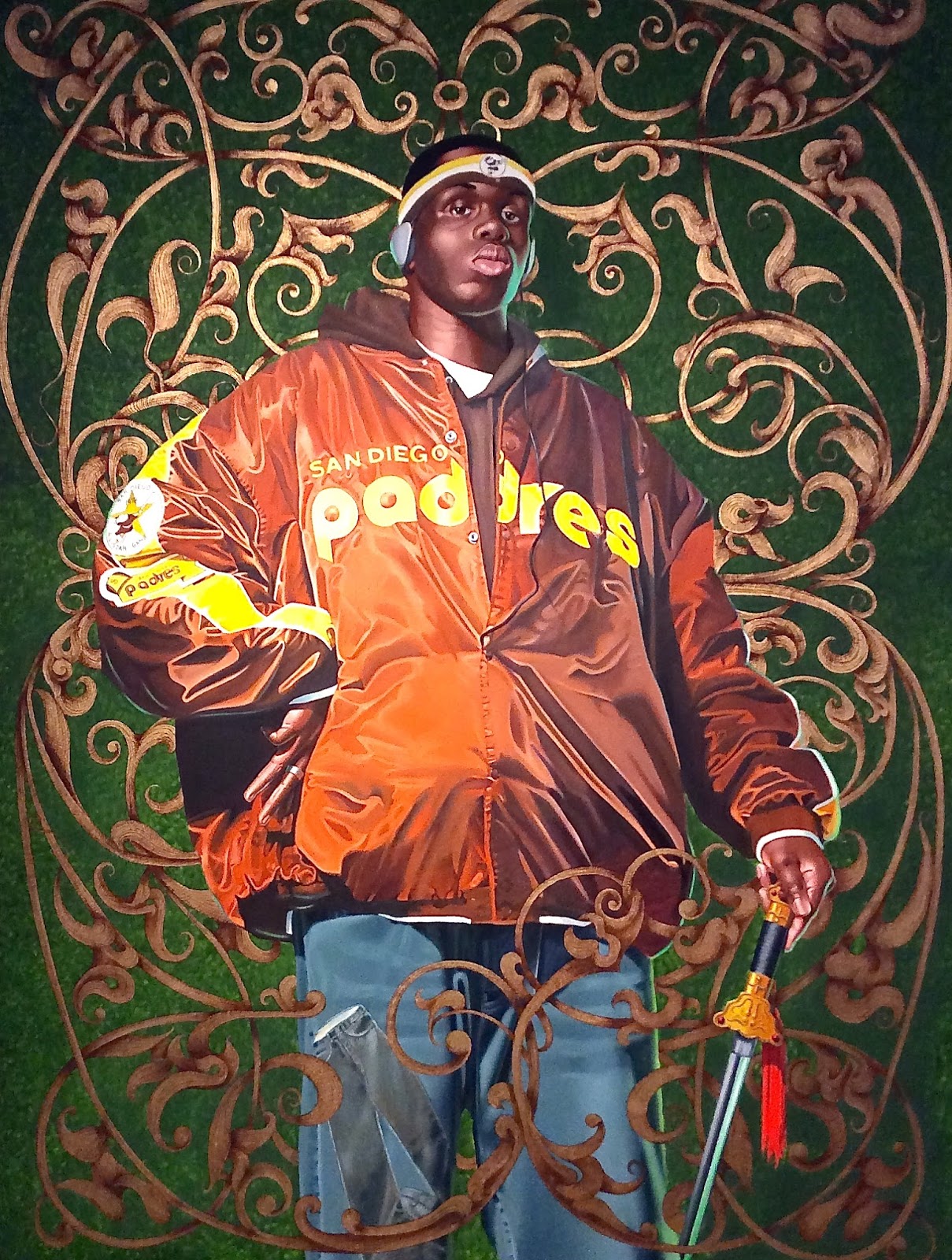
Mickalene Thomas' male counterpart is Kehinde Wiley, who became famous for painting Black men in the manner of the Old Masters. 

Kehinde Wiley, born 1977
Alexander the Great
Jan's iPad
Thomas and Wiley are contemporary, living African American artists. Historical precedent for their approach was set by Robert Colescott. His work is still very powerful. Across the bottom of this painting is the legend, "Wishing on a Prime Time Star." 

Robert Colescott, 1925-2009
Colored TV
Jan's iPad
Another contemporary painter, Chris Ofili, is best known for his paintings that incorporate elephant dung and sparkles. The exhibit had a good example, but it was in terrible light. I'm including it here because of the similarities in style and attitude with the previous examples. The painting rests on two balls of elephant dung, and a similar ball is used as a pendant in a necklace. He created quite an uproar when he titled a similar painting featuring elephant dung, The Holy Virgin Mary.

Chris Ofili, born 1968
Princess of the Posse, 1999
iPad photo
Many other artists were represented, for a total of fifty works of art; about six or eight were important. If you are interested in contemporary African American art, Thomas, Wiley, and Ofili are the artists to watch for.

After a pleasant stroll through Yerba Buena Gardens, we came to the Contemporary Jewish Museum, a venue for exhibits of both art and history. The most striking thing about this museum is its architecture. Originally, the PG&E power station was in a handsome brick building with traditional decoration. Internationally famous architect Daniel Libeskind was brought in to expand it and turn it into a museum. His addition looks like an irregular shipping container dropped on one corner. Since it is a dark mass in the shade of taller buildings, it's impossible to get a good photo of it.

Contemporary Jewish Museum
by Daniel Libeskind
iPad photo
No photography is allowed within, except for the foyer where a 90-foot long work of art composed of geographical globes is suspended from the ceiling.

David Lane
Lamp of the Covenant
iPad photo
The main exhibit was called "Night Begins the Day." This contained quite a range of artworks that were loosely united by the nebulous theme. Most of the works were interesting, and well-displayed, but only a few artists were famous, such as Josiah McElheny and Fred Tomaselli.

It's not like these museums are about "them"—some group of "others" that we don't have to care about. In principle, all of us derive from the African Diaspora, since Africa was the home of the first humans, who then migrated to different regions and mutated into different types. As far as Jewish culture is concerned, their historical role in creating and conserving American culture can hardly be overstated. Remember that "God Bless America" was composed by Irving Berlin, who meant it with an immigrant's passion. Museums expand our perspective.

The museum district will be enhanced by the addition of the Mexican Museum. Currently located in Fort Mason it is destined to occupy a fine old building on the corner of Mission and Third. The Mexican Museum has a good collection, but its location is out of the way and not good for art. A museum of Latino art would be a perfect complement to the Mission Street cultural corridor.

Tuesday, May 26, 2015

Death of a Salesman: Still Relevant after all these Years

Death of a Salesman is a beautifully written play by Arthur Miller, one of the foremost dramatists of the first half of the 20th century. It concerns day-dreaming versus realistic thinking as realized in the life of a traveling salesman. Toward the end of the play, one of the minor characters sums up the theme: A salesman's gotta dream; it comes with the territory.

The San Jose Stage Company recently revived this classic. Yesterday was the final show of the run, and it was a terrific performance. All the actors conveyed their lines with just the right attitude, just the right tone, just the right pacing. We have seen this play in movies and on TV with big-time actors and big-time emoting, but Miller's lines are even more convincing when delivered by more regular people in a more normal way.

The San Jose Stage Company has a very nice playhouse, just the right size, about 250 seats on three sides of a projecting stage, with no curtains. Even at the back of the house, we were only 10 rows from the action, and the seats are tiered so we could see fine.

During the intermission we happened to meet a traveling sales woman. She was quite excited because a play written long ago related to her current concerns.

But everyone has the problem of what to do about dreams. Somehow you gotta have dreams, but they can get you into a lot of trouble, and keep you from finding yourself. Your real self has to be grounded in reality, as well as you can figure it out.

Sunday, May 24, 2015

LA County Arboretum: Glamorous Garden

What makes a public arboretum glamorous? Peacocks, for one thing. The Arboretum boasts a resident flock of wild peacocks, strutting and posing like starlets.

I took this and all the photos in this post with my iPad.
A wide range of exotic and mature plants is attractively arranged. You can tell these plants have been here a long time because of their great size.


Artfully designed and carefully maintained gardens are part of the glamour.

The Rose Garden
And for a final glamorous touch, there's even a Hollywood set: a Queen Anne style cottage that was used in an old TV show called "Fantasy Island." Many's the time I've watched Tattoo call out "Da plane, da plane" from the tower.

Queen Anne Cottage
This cottage points us toward the history of the Arboretum. This land was originally part of Rancho Santa Anita, a large fertile area with good water resources. In 1875 it was purchased by an investor and real estate speculator known as "Lucky" Baldwin. It was he who imported the peafowl from India to adorn the estate, and it was he who built a woodwork encrusted cottage as a Guest House.

Friendly docents provide background information.

Docent and Dan
The Arboretum is located in Arcadia, but you can feel the nearness of Hollywood.

These wood relief carvings hanging in the Visitor Center express the mood.